Banking & Risk Analytics
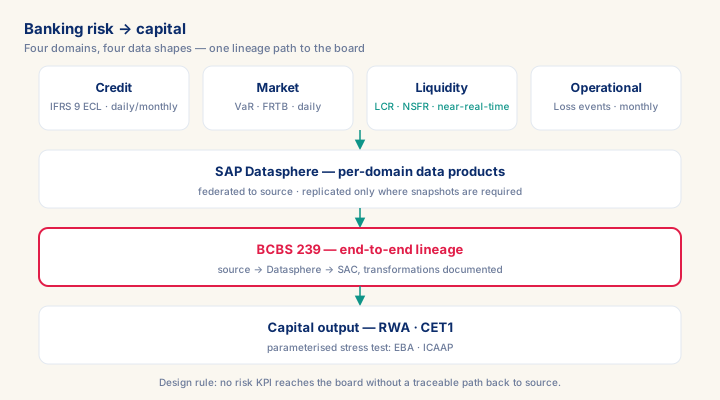
As of 2026-10-04
Banking is the most regulation-dense SAP vertical and the largest EMEA demand pool (22%,). Four risk domains with different latency/granularity/audit profiles: credit (IFRS 9 ECL 3-stage, AnaCredit), market (VaR, FRTB), liquidity (LCR/NSFR — the only near-real-time one), operational. BCBS 239 lineage is the governance backbone — every risk KPI must trace end-to-end from S/4HANA subledger → Datasphere → SAC, or it's a regulatory finding. RWA/CET1 capital + parameterised stress tests are the real output. The premium goes to regulation-fluent architects, not build-only consultants.
What you will learn
- Model credit, market, liquidity, and operational risk as four separate data shapes — not one merged risk mart
- Design BCBS 239 lineage into the Datasphere data products from day one, source to SAC dashboard
- Decide when to replicate vs. federate AnaCredit/FRTB data, and when liquidity reporting must be near-real-time
- Defend a parameterised, re-runnable stress-test model and a reconciled RWA/CET1 number under regulator scrutiny
Module overview
Banking analytics is the most regulation-dense vertical in the SAP estate, and the single biggest demand pool — Banking & Insurance is the largest slice of EMEA SAP analytics demand at 22%. A consultant who can speak the regulatory language fluently — not just build dashboards — commands the strongest day-rate premium in the field.
Four risk domains, four data shapes. (1) Credit risk — probability of default, exposure at default, loss given default; the IFRS 9 expected-credit-loss (ECL) model with its 3-stage staging logic; AnaCredit granular loan-level reporting to the ECB. (2) Market risk — value-at-risk, sensitivities, the FRTB (Fundamental Review of the Trading Book) capital framework. (3) Liquidity risk — LCR (liquidity coverage ratio), NSFR, intraday liquidity — the only domain that genuinely needs near-real-time, not batch. (4) Operational risk — loss-event data, scenario analysis. Each domain has a different latency, granularity, and audit profile; treating them as one "risk mart" is the classic junior error.
Prerequisites
- Intermediate hands-on experience on SAP analytics projects
- Review core concepts first: C087, C083, C046
Outcomes
- Work through a realistic scenario: European mid-tier bank, S/4HANA financial products subledger, IFRS 9 + AnaCredit + LCR reporting obligations, regulator demanding BCBS 239 lineage evidence.
- Recognize and avoid the anti-pattern: One merged 'risk mart' for all four domains — Wrong latency/granularity per domain; audit nightmare.
- Apply the module's core decision: Risk-mart structure — choose Separate marts per risk domain (different shapes), not One 'risk mart' merging credit/market/liquidity.
- Track mastery with the KPI: Risk-KPI lineage coverage (target: 100% trace to source (BCBS 239); red flag: Any board/regulator KPI with no traceable source).
Full module available to members. The full module adds: the decision framework · the end-to-end scenario walkthrough · the KPI scorecard · the anti-patterns · the code blocks · the knowledge check · the diagrams.