Joule Pricing & Consumption — AI Units and the Business AI Commercial Model
As of 2026-10-04
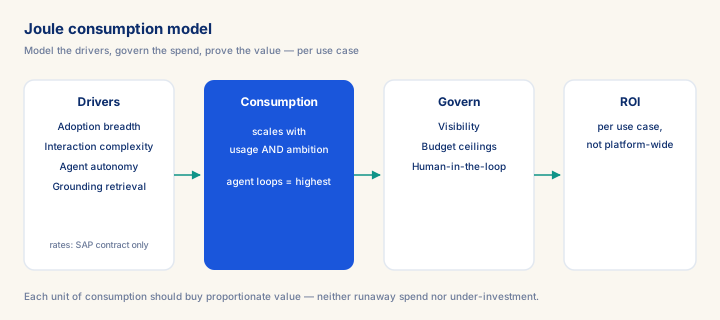
SAP's paper 'Understanding SAP's Business AI Commercial Model' (version 09.2026) sets three layers: Base AI (Joule Base and embedded AI, included in cloud subscriptions), Premium AI (Joule Agents, high-value features, SAP Joule for Consultants) paid in AI Units, and custom-built AI (design time free, runtime via BTPEA/CPEA/PAYG; productive Joule Studio runtime free through 2026). AI Units are bought yearly (SKU 8019164) into one shared pool, expire after 12 months and are monitored in SAP for Me. Published rates: 0.02 AI Units per agent action; 35 per Joule for Consultants user per month (22,900 pooled requests, overage 2 per 1,000); 0.005 per Document Grounding record indexed. Neither the paper nor SAP Learning publishes a currency price per AI Unit; SAP's Joule for Consultants product page shows a worked example at a €7 list price (5 × 12 × 35 = 2,100 AI Units ≈ €14,700), subject to change — a product-page example, not a contract price. Forecast per capability and driver, then govern with visibility, agent limits and a stop switch.
What you will learn
- Explain SAP's three-layer Business AI commercial model (Base AI, Premium AI, custom-built AI) and what changed in 2026: per-action agent pricing, assistants not priced separately, retirement of per-user Joule Premium packages.
- Use the published unit rates — 0.02 AI Units per agent action, 35 AI Units per Joule for Consultants user per month, 0.005 per Document Grounding record — without ever inventing the contract price of an AI Unit.
- Build a driver-based consumption forecast per capability (tasks × actions, users, records, requests) and size the shared AI Unit pool against its 12-month expiry.
- Govern live consumption with SAP for Me visibility, agent step and retry limits, a stop switch and monthly actual-versus-forecast reviews.
Joule pricing is no longer a guessing game, and a consultant who still says "it depends on your contract" and stops there is now behind the market. In September 2026 SAP published a customer paper, Understanding SAP's Business AI Commercial Model (version 09.2026), that states the structure, the unit of account and several unit rates in plain numbers. The paper does not publish a currency price for that unit of account, and neither does SAP Learning; the only public euro figure is a worked example on SAP's Joule for Consultants product page (see below), which is not a contract price. This module teaches you the model as SAP describes it, how to turn it into a consumption forecast a CFO can sign, and how to govern the spend once agents are live.
The model in three layers
SAP organises business AI commercially into three layers:
Prerequisites
- Familiarity with Joule and Joule agents (M046, M049)
- Review core concepts first: C333, C101, C148
Outcomes
- Classify a client's planned AI use into Base AI, Premium AI and custom-built AI.
- Compute a monthly and annual AI Unit forecast from published rates and measured drivers, with the contract price as a separate input.
- Identify the dominant cost line in a forecast (often the per-user product, not the agent) and the most uncertain one (actions per task).
- Set up the governance loop: owner, alerts, stop rules, agent limits, monthly review, renewal on measured consumption.
Full module available to members. The full module adds: the decision framework · the end-to-end scenario walkthrough · the KPI scorecard · the anti-patterns · the code blocks · the knowledge check · the diagrams.