
Decoding a Day Rate: Real Bands by Country, Seniority and Scarcity
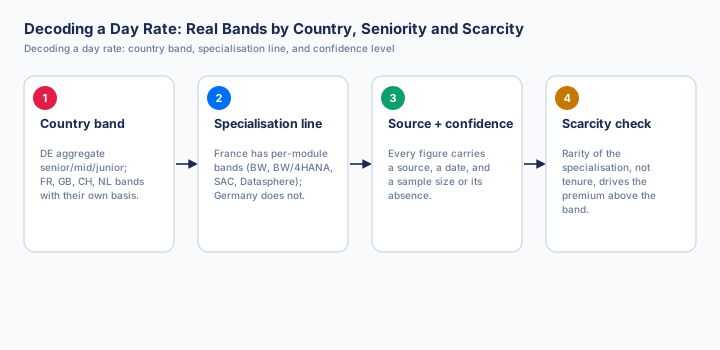
As of 2026-11-08
A candidate's day-rate ask only means something against a country, a seniority band and a specialisation, and no single market rate covers all three. This module reads the sources that could be re-opened on 7 November 2026: France's per-profile grid (LinkQuest, March 2026, about 420 profiles; BW/4HANA + SAC median 680 €), the platform's French senior Datasphere figures (750 € model base, 700 € observed median), Germany's SAP-wide survey summary (median about 1 180 €, analytics about 15% higher) and the platform estimate of 1 148 € (n = 1), the UK's SAP BW contract median of £430 on 31 quoted rates, and Swiss and Dutch general ranges given as estimates. It teaches a five-step pricing procedure, worked triangulations in three countries, a one-page rate note, and why scarcity, not tenure, moves a rate on a specialised stack.
What you will learn
- Read a published day-rate band against its actual country, specialisation and sample size
- Explain why Germany's published SAP analytics rate data is aggregate, not per-module
- Distinguish an intermediary marketplace median from a direct-client rate
- Explain why scarcity, not years of experience, is the stronger driver of rate premiums
The number a candidate names is not the number the market sets
A candidate who asks for 1 200 € a day is not automatically overpriced, and one who asks for 650 € is not automatically a bargain (both are examples): each number only means something against a country, a seniority band and a specialisation. A recruiter or manager who negotiates from a single "market rate" in their head is negotiating against a number nobody published. This module shows what the published sources actually say for SAP analytics day rates, dated and with their sample sizes, and gives a procedure to price one mandate from them.
Scope: which countries this module covers
Day rates are national. The module reads France, Germany, the United Kingdom, Switzerland and the Netherlands, the five markets for which a source could be re-opened on 2026-11-07. Belgium, Luxembourg, Austria, Spain, Italy, the Nordic countries and the Middle East follow the same method, but no figure is given here for them: say so rather than converting a neighbouring country's number. Amounts stay in their own currency (€, £, CHF); no conversion is made in this module.
Prerequisites
- Basic familiarity with SAP product names (BW, BW/4HANA, SAC, Datasphere)
- Review core concepts first: C048, C049
Outcomes
- Read a published day-rate band against its actual country, specialisation and sample size.
- Explain why Germany's published SAP analytics rate data is aggregate.
- Respond to a candidate's rate ask with a grounded, sourced counter-question.
- Recognise when a precise-sounding rate figure is actually a thin-sample signal.
Full module with the Consultant plan — €19.90/month. The full module adds: the decision framework · the end-to-end scenario walkthrough · the KPI scorecard · the anti-patterns · the knowledge check · the diagrams.