Employee or Freelance in SAP Analytics: the Arbitrage, With the Assumptions Shown
As of 2026-08-16
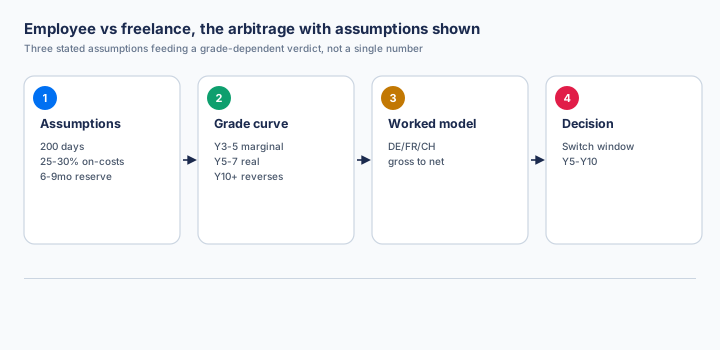
Employee-versus-freelance is not a single number — the Employee Salaries study's comp-inversion math (Part VII) and the Employee -> Consultant study's worked geography models (Part II) both show the gap depends on grade. At Senior Consultant (Y3-Y5) the inversion is marginal and often erased by first-year bench time; at Manager (Y5-Y7) it is real and durable (EUR126-180K net comparable vs EUR105-130K employee); at Senior Manager (Y8-Y10) the two reach rough parity; past Director (Y10+) it reverses. Every number rests on stated assumptions: 200 billable days, 25-30% self-funded on-costs, and a 6-9 month cash reserve given a median 73-day time-to-first-contract (P75: 180 days).
What you will learn
- State the explicit assumptions (billable days, on-costs, cash reserve) behind any freelance-vs-employee comparison before trusting a number.
- Locate your own grade on the comp-inversion curve and read whether the gap is real, marginal, or reversed at that grade.
- Use the worked DE/FR/CH geography models to build your own back-of-envelope comparison.
- Apply the stay-vs-switch synthesis as a rule tied to grade and life stage, not a single verdict.
Why a single "freelance pays more" answer is wrong
The comp-inversion math in the Employee Salaries study (Part VII) and the worked geography models in the Employee -> Consultant study (Part II) triangulate the same question from two directions and land on the same honest answer: it depends on your grade, and the gap is real only within a specific window. Treat any answer that skips the assumptions as marketing, not analysis.
The explicit assumptions, stated once
Every number below rests on: 200 billable days/year (a working assumption, not a guarantee — bench time reduces it); 25-30% self-funded on-costs for a freelancer (pension self-funding ~10%, healthcare ~6% DE/FR ~4% UK, paid-leave equivalent ~5%, sick-day equivalent ~2%, professional indemnity insurance ~1%, admin overhead ~2%); and a 6-to-9-month cash reserve before launch, because the median time to a first freelance contract is 73 days but the P75 is 180 days (Eursap Q1 2026 cohort, N=89), and a 30-60 day invoice cycle can push the first cash-in 5-7 months past launch.
Prerequisites
- Current salaried status inside an SAP analytics employer — this module compares against your actual employee comp, not an estimate.
- Review core concepts first: C065, C314.
Outcomes
- Reconstruct the employee-vs-freelance net comparable for their own country and grade, with assumptions stated.
- Explain why the inversion is durable at Manager grade but not at Senior Consultant grade.
- State the 9-month cash-reserve rule and why it is conservative rather than arbitrary.
- Decide, with an explicit rationale, whether their own situation sits in the canonical Y5-Y10 switch window.
Full module available to members. The full module adds: the decision framework · the end-to-end scenario walkthrough · the KPI scorecard · the anti-patterns · the knowledge check · the diagrams.