
SAP AI Explained — the book on SAP Business AI, Joule and Business Data Cloud
As of 2026-11-27
SAP AI Explained — Joule, agents and Business Data Cloud — architecture, real costs and the decisions to make before 2027
Last updated 12 November 2026
SAP has shipped the platform for the autonomous enterprise, not the autonomous enterprise itself. This book sorts what is generally available from what is only announced, puts a price on Joule, agents and Business Data Cloud wherever SAP has published one, and sequences the twelve decisions a large SAP customer has to make before the end of 2027.
Get the book
Already a subscriber, or already bought it? No need to buy it again: Open the book →
One-off payment, VAT included. Read online on Analytics Legends — updated every week, every update included.
Included in every Analytics Legends subscription — Consultant from €14.92/month billed annually (€179/year), or €19.90 monthly. See the plans →
Subscribers and buyers read the book in the reader on the Analytics Legends home page. Open the book →
Table of contents — 687 pages, 23 chapters
I — Why: the shift
- From application suite to autonomous enterprise
- Traction versus usage: AI in deals, not yet in production
- The SAP Business AI Platform on one map
II — What: the platform, layer by layer
- Joule Work: from screen to task
- The agent catalog, function by function
- Joule Studio: building agents, and the 2027 bill
- AI Foundation: choice of model, not of price
- The Knowledge Graph, SAP's real moat
- Business Data Cloud and data products
- SAP Databricks, BDC Connect and zero-copy
- BW → BDC: four paths, five deadlines
- SAC and Enterprise Planning for agents
- MCP, A2A and the AI Agent Hub
III — How: build, secure, comply
- Five reference architectures
- Securing agents that act
- The AI Act timeline and the burden of proof
IV — How much: economics, proof, market, skills
- The real cost: AI units and capacity units
- Evidence-weighted ROI
- The market: Microsoft, hyperscalers, lakehouses, integrators
- Three new roles and the skills gap
V — What next: programme and roadmap
- Pilot to scale: twelve decisions before 2027
- 2026–2030: three scenarios, twelve signals
VI — Appendices
- Appendix: glossary, catalogs, sources
Read an excerpt — SAP Business AI Platform, Joule, BW → BDC
Pages from three chapters, exactly as they appear in the book: dated figures, named sources, exhibits built from SAP sources and the Analytics Legends database.
Chapter 3
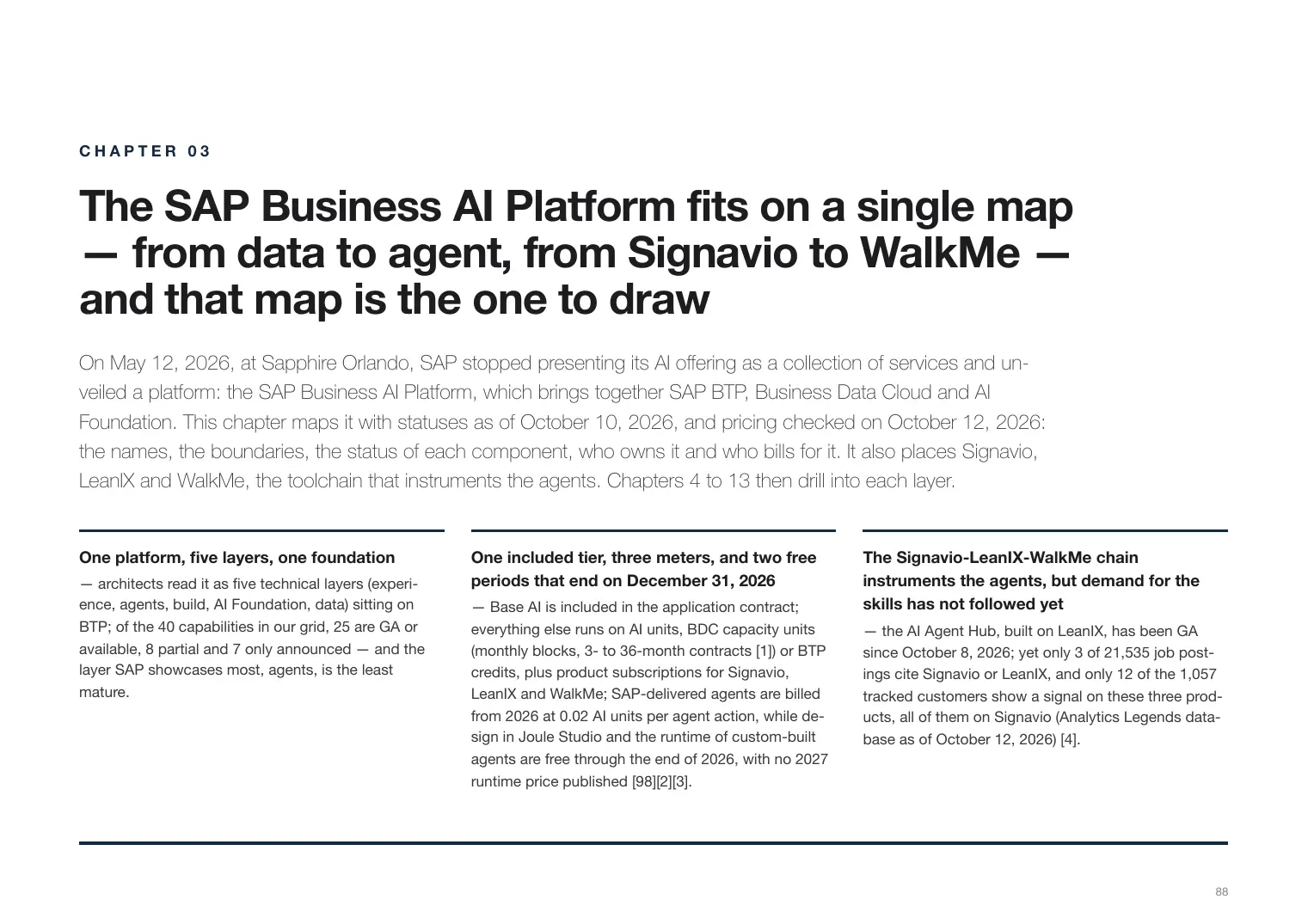
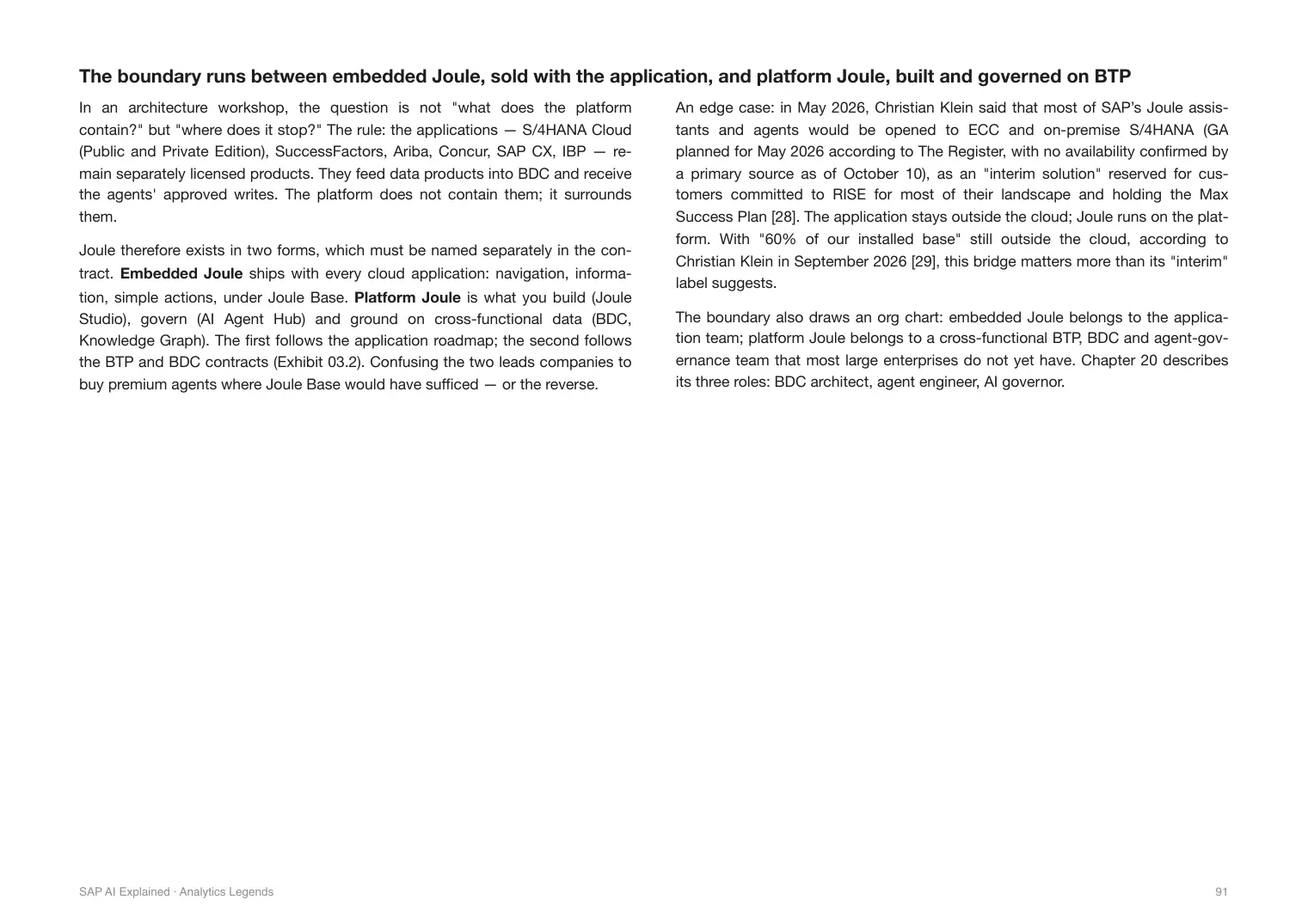
The SAP Business AI Platform fits on a single map — from data to agent, from Signavio to WalkMe — and that map is the one to draw
On May 12, 2026, at Sapphire Orlando, SAP stopped presenting its AI offering as a collection of services and unveiled a platform: the SAP Business AI Platform, which brings together SAP BTP, Business Data Cloud and AI Foundation. This chapter maps it with statuses as of October 10, 2026, and pricing checked on October 12, 2026: the names, the boundaries, the status of each component, who owns it and who bills for it. It also places Signavio, LeanIX and WalkMe, the toolchain that instruments the agents. Chapters 4 to 13 then drill into each layer.
- One platform, five layers, one foundation — architects read it as five technical layers (experience, agents, build, AI Foundation, data) sitting on BTP; of the 40 capabilities in our grid, 25 are GA or available, 8 partial and 7 only announced — and the layer SAP showcases most, agents, is the least mature.
- One included tier, three meters, and two free periods that end on December 31, 2026 — Base AI is included in the application contract; everything else runs on AI units, BDC capacity units (monthly blocks, 3- to 36-month contracts) or BTP credits, plus product subscriptions for Signavio, LeanIX and WalkMe; SAP-delivered agents are billed from 2026 at 0.02 AI units per agent action, while design in Joule Studio is free under fair use with no end date and the runtime of custom-built agents is billed on consumption through BTPEA, CPEA or pay-as-you-go, free until December 2026 only for select customers.
- The Signavio-LeanIX-WalkMe chain instruments the agents, but demand for the skills has not followed yet — the AI Agent Hub, built on LeanIX, has been GA since October 8, 2026; yet only 3 of 21,535 job postings cite Signavio or LeanIX, and only 12 of the 1,057 tracked customers show a signal on these three products, all of them on Signavio (Analytics Legends database as of October 12, 2026).
Chapter 4
Joule Work replaces the screen with the task — at SAP first (110,000 employees), at customers next
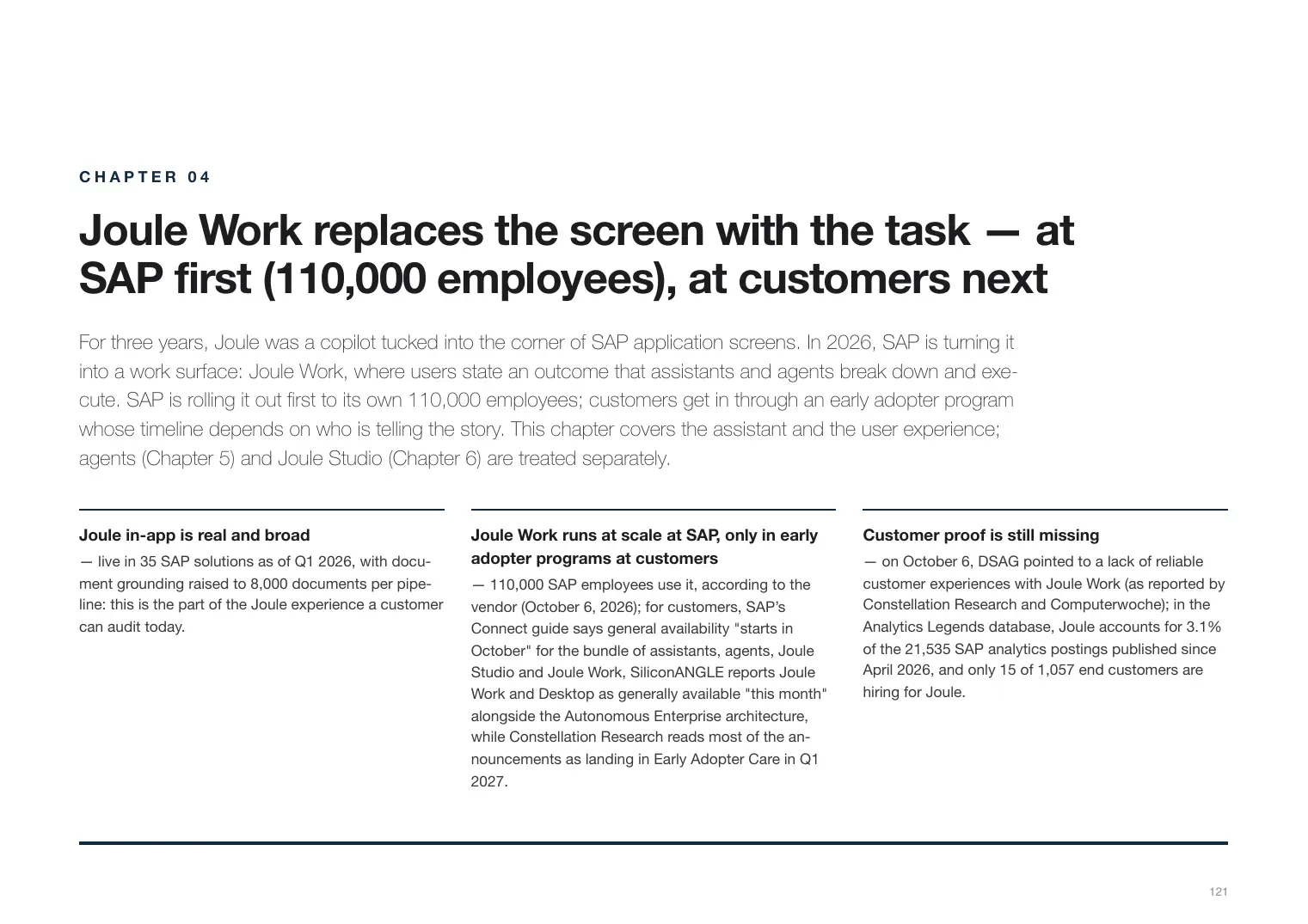
For three years, Joule was a copilot tucked into the corner of SAP application screens. In 2026, SAP is turning it into a work surface: Joule Work, where users state an outcome that assistants and agents break down and execute. SAP is rolling it out first to its own 110,000 employees; customers get in through an early adopter program whose timeline depends on who is telling the story. This chapter covers the assistant and the user experience; agents (Chapter 5) and Joule Studio (Chapter 6) are treated separately.
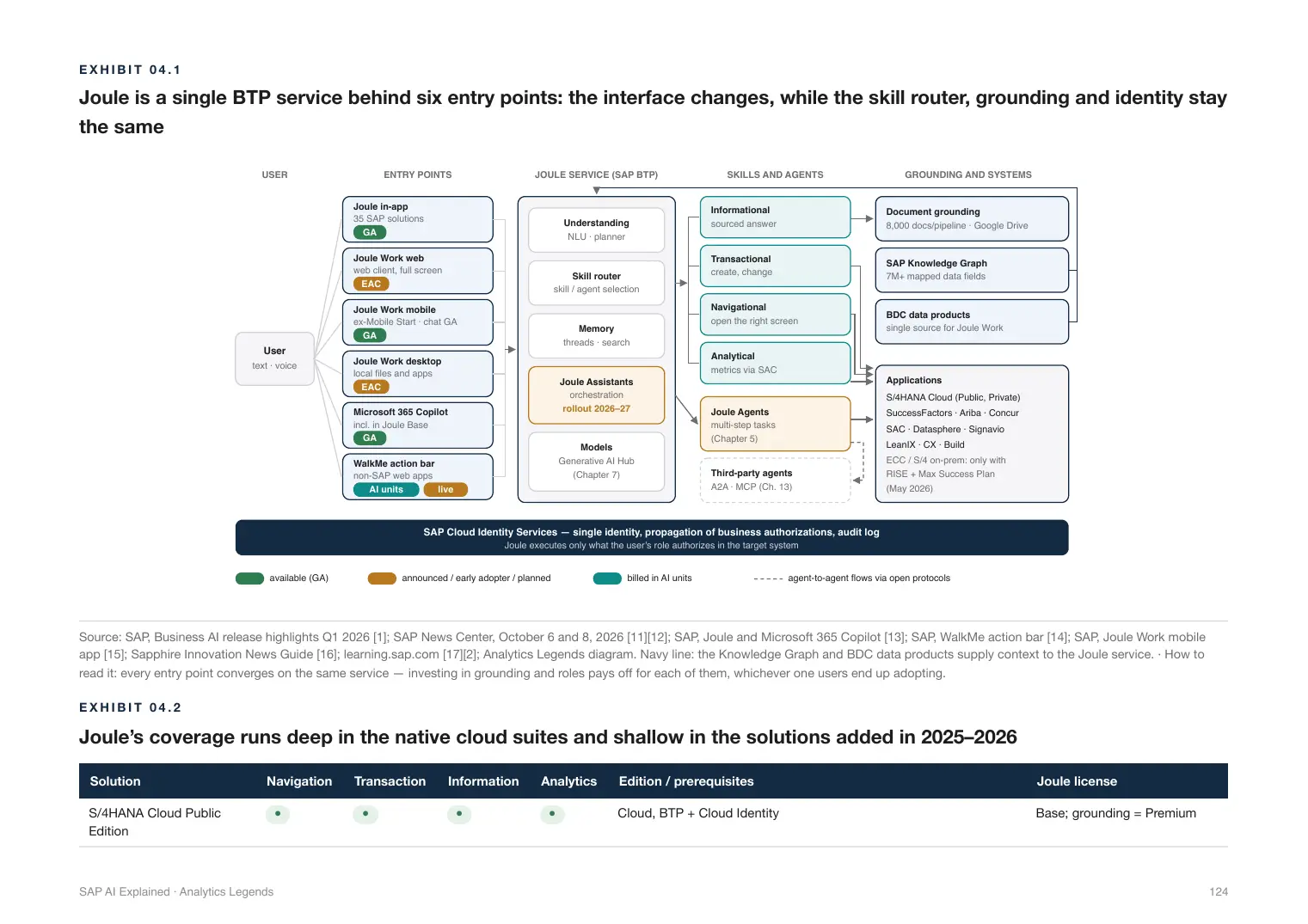
- Joule in-app is real and broad — live in 35 SAP solutions as of Q1 2026, with document grounding raised to 8,000 documents per pipeline: this is the part of the Joule experience a customer can audit today.
- Joule Work runs at scale at SAP, only in early adopter programs at customers — 110,000 SAP employees use it, according to the vendor (October 6, 2026); for customers, SAP's Connect guide says general availability "starts in October" for the bundle of assistants, agents, Joule Studio and Joule Work, SiliconANGLE reports Joule Work and Desktop as generally available "this month" alongside the Autonomous Enterprise architecture, while Constellation Research reads most of the announcements as landing in Early Adopter Care in Q1 2027.
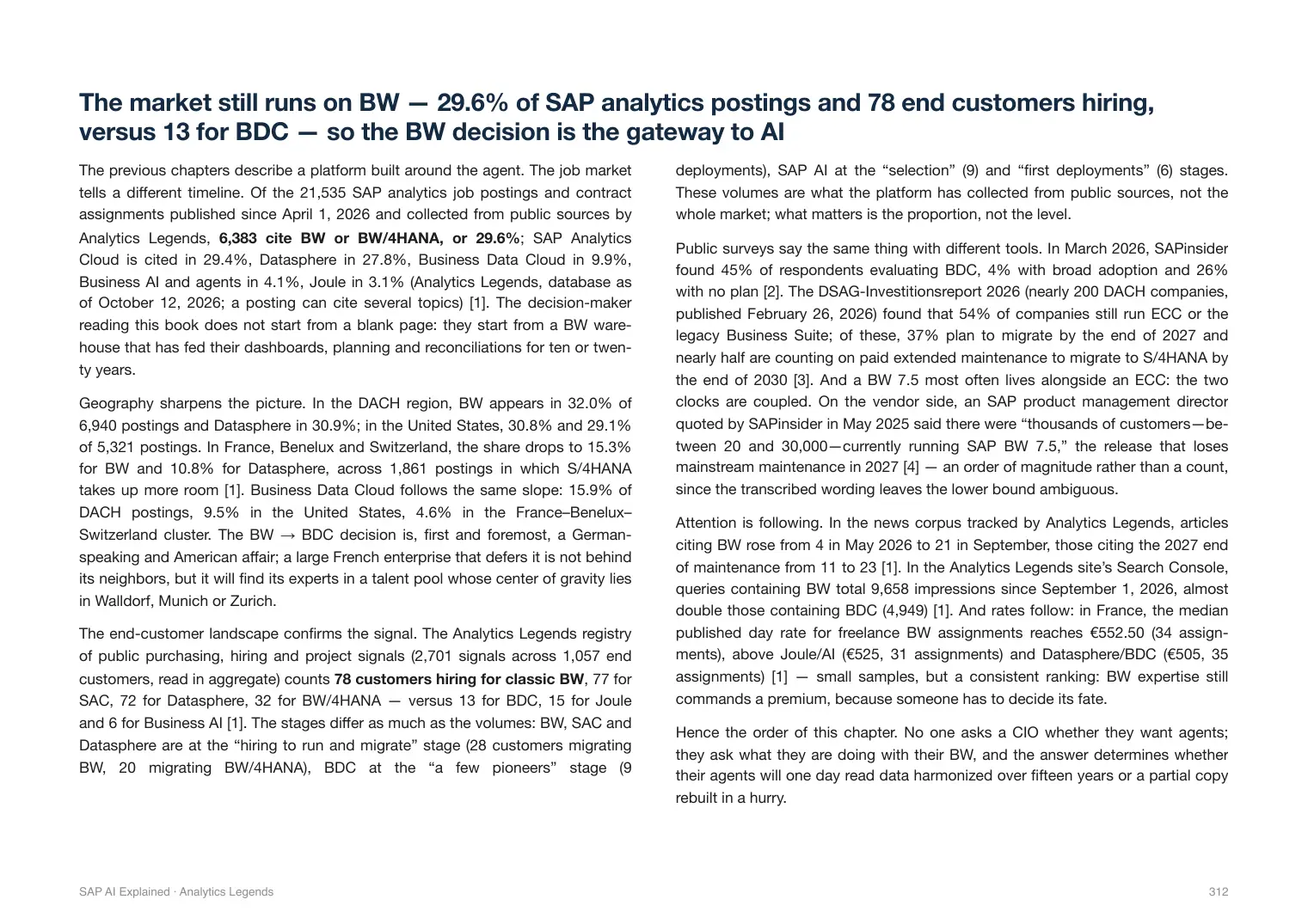
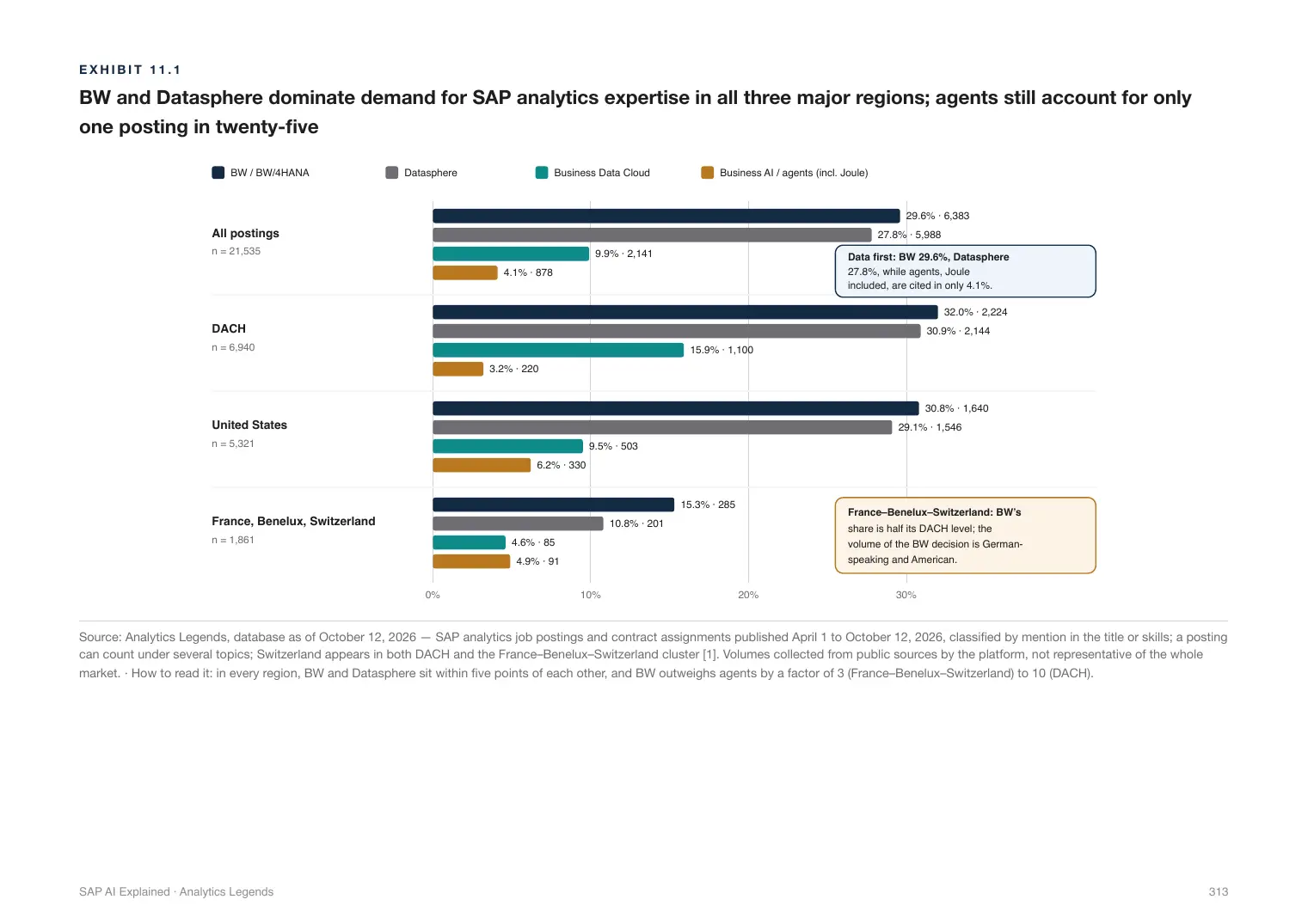
- Customer proof is still missing — on October 6, DSAG pointed to a lack of reliable customer experiences with Joule Work (as reported by Constellation Research and Computerwoche); in the Analytics Legends database, Joule accounts for 3.1% of the 21,535 SAP analytics postings published since April 2026, and only 15 of 1,057 end customers are hiring for Joule.
Chapter 11
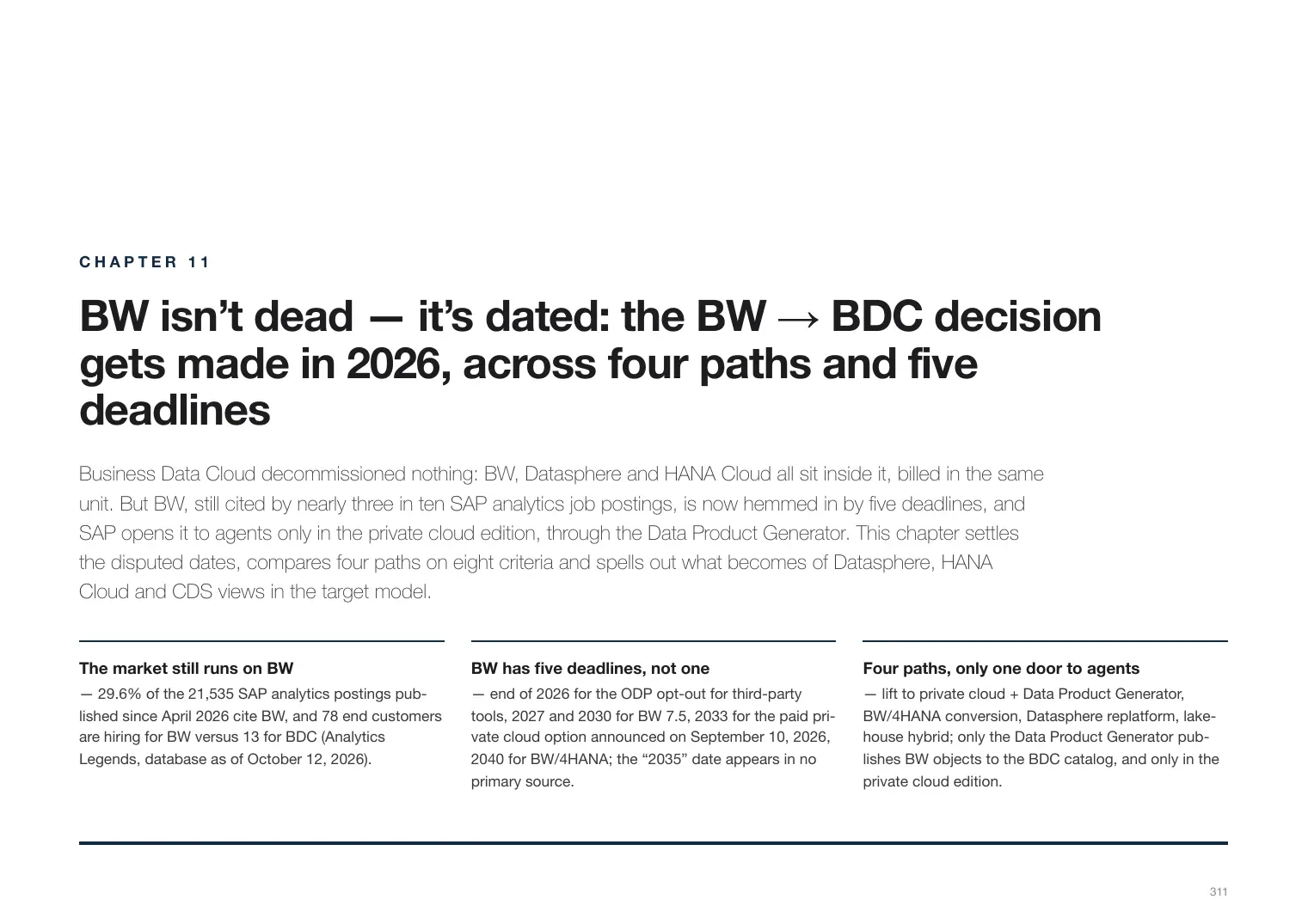
BW isn’t dead — it’s dated: the BW → BDC decision gets made in 2026, across four paths and five deadlines
Business Data Cloud decommissioned nothing: BW, Datasphere and HANA Cloud all sit inside it, billed in the same unit. But BW, still cited by nearly three in ten SAP analytics job postings, is now hemmed in by five deadlines, and SAP opens it to agents only in the private cloud edition, through the Data Product Generator. This chapter settles the disputed dates, compares four paths on eight criteria and spells out what becomes of Datasphere, HANA Cloud and CDS views in the target model.
- The market still runs on BW — 29.6% of the 21,535 SAP analytics postings published since April 2026 cite BW, and 78 end customers are hiring for BW versus 13 for BDC (Analytics Legends, database as of October 12, 2026).
- BW has five deadlines, not one — end of 2026 for the ODP opt-out for third-party tools, 2027 and 2030 for BW 7.5, 2033 for the paid private cloud option announced on September 10, 2026, 2040 for BW/4HANA; the “2035” date appears in no primary source.
- Four paths, only one door to agents — lift to private cloud + Data Product Generator, BW/4HANA conversion, Datasphere replatform, lakehouse hybrid; only the Data Product Generator publishes BW objects to the BDC catalog, and only in the private cloud edition.
Excerpt from the prologue
Prologue — nine of the twelve decisions fall due before April 1, 2027: this book in 20 minutes
This prologue is written for the CIO, the architect and the chief data officer of a large SAP customer who must make their calls before the end of 2027 without the time to read twenty-three chapters. In a few pages, it sets out the twelve decisions in the order the calendar imposes, the 2026–2028 calendar itself, a typical program budget, and what this book is not. Figures are dated and point to the chapter that substantiates them.
The gap between the vendor and its customers can be measured. On SAP's side: more than 200 agents and more than 20 assistants claimed at SAP Connect (October 5–7, 2026), a target of more than 400 agents by year-end, and Joule Work live for 110,000 of the vendor's own employees. On the customer side: 45% of companies surveyed by SAPinsider are still evaluating Business Data Cloud and 4% have deployed it broadly; 77% of DSAG respondents with AI use cases run them, in production or in use, on non-SAP solutions; 3% rely on an SAP solution for them. […]
The method comes down to three rules, applied across all twenty-three chapters. Every capability carries a status (GA, partial, announced), a source and a date. Every vendor figure is flagged as such, and so is every Analytics Legends estimate, with its assumptions and its range. […] Where SAP has published nothing, the book says so: that is the case for the 2027 price of agents, the euro price of the capacity unit, and a formally dated GA for the new Joule Studio.
Who it is for
CIOs, enterprise and data architects, chief data officers, SAP practice leads and consultants who need dated facts — statuses, prices, deadlines — rather than vendor messaging, before a negotiation with SAP, an architecture board or a programme committee.
Practical questions
Is there a PDF or a download?
No. The book is read online on Analytics Legends, by buyers and subscribers alike, so that every weekly update reaches every reader on the day it is published.
How often is it updated?
Every week. Statuses, prices and dates move with SAP's announcements; buyers and subscribers receive every update at no extra cost.
Which editions are available?
English, French and German. The reader opens the edition in the language you browse the site in.
Independent analysis — not affiliated with, endorsed or sponsored by SAP SE. SAP and SAP product names are trademarks of SAP SE.