Agent Orchestration in BDC
As of 2026-10-04
Orchestration turns single agents into systems — agent to subagent, agent to skill, agent to MCP tool, Joule to pro-code agent over A2A, workflow to agent, and Joule Assistants coordinating agents in Joule Work. Each hand-off multiplies cost, latency, loops and identity risk. Two rules decide most designs: put state and waiting in a workflow (n8n in the new Joule Studio, or SAP Build Process Automation), not in an agent loop; and split subagents by authority, not by topic. Configure the documented controls per agent (routing descriptions, max thinking steps, tool lists, MCP timeouts — 200 s by default — output contracts), design what the tool cannot (hand-off contracts, identity per hop, human checkpoints, cost in actions across the chain), ground every fact on one source (Business Data Cloud data products, systems of record, a single policy index), and prove it with Timeline traces, a regression pack and the AI Agent Hub registry.
What you will learn
- Choose the right orchestration pattern (skill, single agent, parent with subagents, A2A to a pro-code agent, workflow calling agents, assistant routing) for a given requirement and justify it
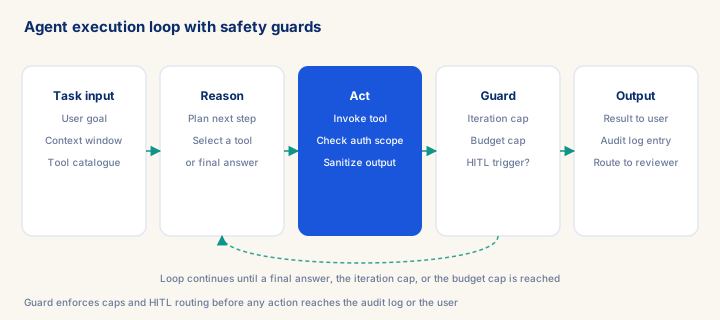
- Diagnose the five recurring failure modes — loop divergence, wrong tool, delegation ping-pong, prompt injection through tool data, timeouts — in Joule Studio traces and apply the matching control
- Design the hand-off contracts, identity per hop and human checkpoints of a multi-agent chain, grounded on governed data products
- Estimate the cost of an orchestration in agent actions across the whole chain and produce an orchestration design record
Orchestration is where single agents become systems: one agent delegating to another, a Joule assistant coordinating several agents, a workflow calling an agent and waiting for a person, a Joule agent handing a task to a pro-code agent over A2A. Each hand-off multiplies what can go wrong — cost, latency, loops, lost context, identity — and each is where production deployments stall. This module teaches the orchestration patterns available in SAP's stack in September 2026, the controls that keep them bounded, the observability you need to prove they work, and the business data grounding (Business Data Cloud data products, SAP Knowledge Graph) that makes their answers worth acting on. Prerequisites: M326 (building an agent) and M327 (MCP and A2A).
1. The orchestration layers in SAP's stack
Read the stack from the user down.
Prerequisites
- Module M326 (Building Joule Agents with Joule Studio) and M327 (MCP & A2A for SAP Systems)
- Review core concepts first: C131, C162, C163
Outcomes
- Draw an orchestration with protocol and identity per hop and defend each hand-off.
- Fix delegation ping-pong with subagent descriptions and structured outputs, proven in the Timeline.
- Move waiting and approvals from agent loops into workflow steps and quantify the step savings.
- Deliver an orchestration design record a governance board can approve.
Full module available to members. The full module adds: the decision framework · the end-to-end scenario walkthrough · the KPI scorecard · the anti-patterns · the code blocks · the knowledge check · the diagrams.