AI Ethics in the Enterprise — from SAP's Policy to Your Artefacts
As of 2026-10-04
Enterprise AI ethics is an operating discipline, not a policy document. SAP's own model is the reference: a Global AI Ethics Policy grounded since 2024 in the UNESCO Recommendation on the Ethics of AI (ten principles, extended to generative AI, partners and all employees), an internal AI Ethics Steering Committee, an external AI Ethics Advisory Panel, a handbook, and a review process in which high-risk use cases escalate and can be stopped; SAP's AI management system is ISO/IEC 42001-certified for Joule, SAP AI Core and SAP AI Launchpad. A senior consultant scales that model to the client and turns principles into dated artefacts: a use-case register with triage, review records, transparency at the point of decision, oversight that can change outcomes, stratified bias checks, retention rules and a named owner — mapped to the EU AI Act (Articles 10, 13, 14, 26, 27, 50, 86) and GDPR Article 22 where they apply.
What you will learn
- Describe SAP's AI ethics model — Global AI Ethics Policy (UNESCO-based, ten principles), Steering Committee, external Advisory Panel, handbook, escalation and stop rule, ISO/IEC 42001 scope — and scale it to a client
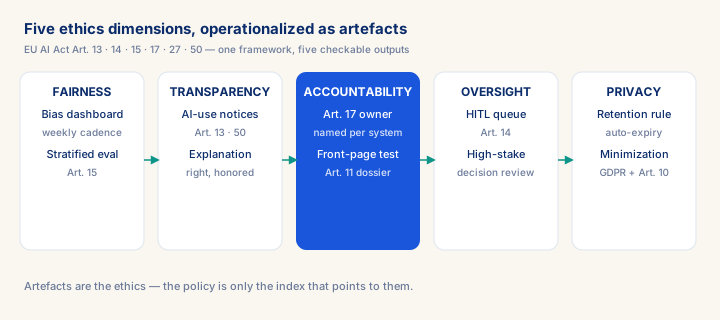
- Turn ethical principles into seven dated artefacts: register with triage, review record, point-of-decision transparency, effective oversight, stratified evaluation, retention rules, named owner
- Anchor each artefact in SAP controls (orchestration data masking and content filters, identity propagation, inference observability, AI Agent Hub) and in the applicable law (EU AI Act Articles 10, 13, 14, 26, 27, 50, 86; GDPR Article 22)
- Run an ethics review of a generative or agentic use case covering delegation limits, non-malicious misalignment and workforce consultation
Ethics in enterprise AI is the discipline that turns "we built an AI feature" into "we built an AI feature the organisation would defend in front of a regulator, a journalist, a works council or the person affected by its output". It overlaps with legal compliance but is wider: most AI features in an SAP landscape are not high-risk under the EU AI Act, yet they still rank suppliers, draft messages to customers, summarise employee feedback or act on a user's behalf. Law sets the floor for a few use cases; ethics is how an organisation decides what it will and will not do everywhere else — and proves it.
The reference model: how SAP governs its own AI
The fastest way to design a client's AI ethics set-up is to understand the one SAP runs for its own products, because the client will be buying and extending those products.
Prerequisites
- Review core concepts first: C029, C194, C120
- Companion module M050 (EU AI Act) recommended
Outcomes
- Explain to a sponsor what SAP's certification and policy cover and what remains the client's responsibility under the shared-responsibility split
- Produce a one-page policy index pointing to live artefacts for a real AI feature, instead of a stand-alone policy
- Detect automation bias in an oversight queue using override trends, sampling and seeded known-wrong items
- Plan workforce consultation (workers' representatives, works councils, CSE) as a scheduled delivery step for HR-facing AI
Full module available to members. The full module adds: the decision framework · the end-to-end scenario walkthrough · the KPI scorecard · the anti-patterns · the code blocks · the knowledge check · the diagrams.