
Rate Negotiation for SAP Freelancers
As of 2026-11-08
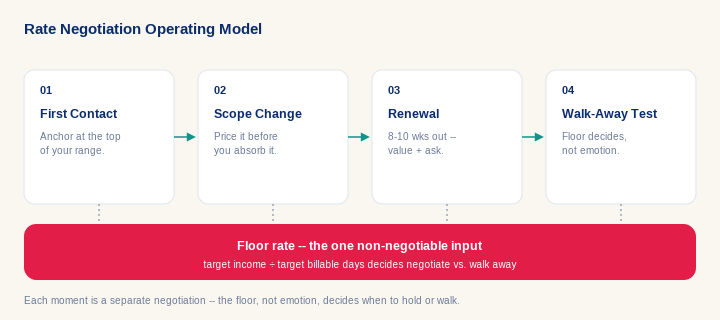
Rate Negotiation for SAP Freelancers turns the day-rate conversation from a single awkward moment into four repeatable negotiations — first contact, scope change, renewal, and walk-away. The number that matters: a senior Datasphere architect's EMEA band is published by stack, country and seniority on the platform's day-rate benchmark, and staffing agencies typically keep 15–25% of the client invoice rate as margin. The module gives the anchoring language, the four pushback responses, and the floor-rate calculation that decides when to accept, escalate, or walk.
What you will learn
- Anchor a day-rate negotiation with a credible, evidence-based number — and justify it in under a minute.
- Price scope changes and contract renewals instead of absorbing them into the existing rate.
- Handle the four recurring pushback scenarios (budget caps, cheaper profiles, fixed-price requests, internal-equity objections) without conceding the anchor.
- Calculate your floor rate and walk away from an under-floor engagement without damaging the relationship.
Why Rate Negotiation Is a Skill, Not a Number
Most SAP analytics freelancers leave money on the table — not because they lack technical ability but because they treat rate negotiation as a single awkward moment rather than a structured, ongoing professional practice. The day-rate conversation happens multiple times per engagement: at first contact with a recruiter or client, during contract renewal, when scope expands mid-engagement, and at the transition between a fixed-term and a rolling extension. Each of these moments has different dynamics, different leverage points, and different failure modes.
Prerequisites
- Review core concepts first: C047, C087, C048
Outcomes
- Work through a realistic scenario: A senior SAP Datasphere architect is engaged through a staffing agency for a DACH automotive OEM's reporting migration. The first-contact rate conversation, a mid-engagement scope expansion, the six-month renewal, and a below-floor counter-offer each test a different negotiation muscle.
- Recognize and avoid the anti-pattern: Answering 'what's your rate?' with 'what's the budget?' — You surrender the anchor, and the final number lands closer to the client's opening reference than to yours.
- Apply the module's core decision: Anchor first, or wait for the client's number? — choose: Name a number first, at the top of your credible range, backed by two or three specific value points; avoid: Answering 'what are your expectations?' with 'what's the budget?' — that surrenders the anchor to the other side.
- Track mastery with the KPI: Anchor discipline (target: You name the first number in at least 9 of your last 10 new-engagement conversations; red flag: You wait for the recruiter's or client's number more than once in five conversations).
Full module with the Consultant plan — €19.90/month. The full module adds: the decision framework · the end-to-end scenario walkthrough · the KPI scorecard · the anti-patterns · the knowledge check · the diagrams.