Practice Leadership
As of 2026-10-10
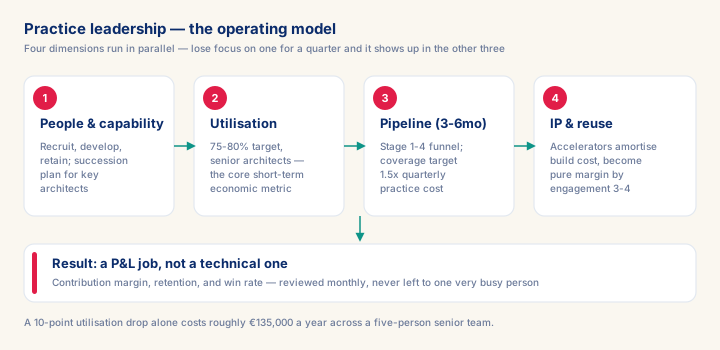
Practice leadership is a P&L job, not a technical one: the practice lead is judged on utilisation, pipeline coverage, and margin, not on the last SAC story shipped. The number that matters most is utilisation — a senior architect billing 70% instead of 80% costs roughly €27,000 a year at a €1,100 blended day rate, and a five-person team with that gap loses about €135,000. With the EMEA BDC/Datasphere architect pool estimated under 2,000 against demand for over 10,000 by 2028, the practices that compound are the ones that treat pipeline coverage (1.5x quarterly cost target), skills investment (5-8% of revenue), and IP reuse as disciplines with numbers attached, not aspirations. Get this right and a practice lead earns the day-rate premium that comes with running a capability rather than delivering one.
What you will learn
- Work through a realistic scenario: A 12-person SAP analytics practice at a European systems integrator has deep BW/4HANA delivery skills, but the market is pivoting to Datasphere and BDC.
- Recognize and avoid the anti-pattern: Staying the 'flying player-coach' past 65% personal utilisation — No time is left for pipeline, people development, or IP.
- Apply the module's core decision: How billable should the practice lead personally stay.
- Track mastery with the KPI: Utilisation rate — senior/architect band.
Practice Leadership: Running an SAP Analytics Capability as a Business
Practice leadership is a fundamentally different job from being the best SAP analytics architect on a team. The practice leader's deliverable is not a data model or a SAC story — it is a capability: a group of people who can reliably deliver high-quality SAP analytics outcomes to clients or internal stakeholders, who are growing in skill, who are commercially productive, and who the firm wants to invest in because the practice generates margin. Becoming effective at this requires explicitly understanding the operating model, the economic levers, and the human dynamics that distinguish practices that compound from those that plateau or collapse.
The Practice-Lead Operating Model: Four Dimensions
A mature SAP analytics practice leader operates across four simultaneous dimensions. Losing focus on any one for more than a quarter has measurable consequences on the others.
Prerequisites
- Intermediate hands-on experience on SAP analytics projects
- Review core concepts first: C047, C087, C084
Outcomes
- Work through a realistic scenario: A 12-person SAP analytics practice at a European systems integrator has deep BW/4HANA delivery skills, but the market is pivoting to Datasphere and BDC.
- Recognize and avoid the anti-pattern: Staying the 'flying player-coach' past 65% personal utilisation — No time is left for pipeline, people development, or IP.
- Apply the module's core decision: How billable should the practice lead personally stay.
- Track mastery with the KPI: Utilisation rate — senior/architect band.
Full module available to members. The full module adds: the decision framework · the end-to-end scenario walkthrough · the KPI scorecard · the anti-patterns · the knowledge check · the diagrams.