Partnering with SIs
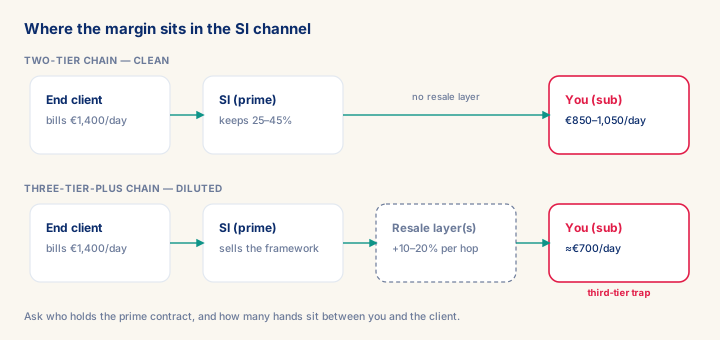
As of 2026-10-05
System integrators control most of the large SAP transformation budget in EMEA, and for an independent consultant the SI channel is the fastest path from one client at a time to a standing pipeline of pre-sold work. The trade is real: an SI typically pays 25–45% below its own client rate, but a well-placed subcontractor runs 85–90% utilization on a framework versus roughly 70% freelancing direct — so annual earnings often favor the SI channel even at the lower day rate. The risk sits in the chain you can't see: work resold through a second or third agency layer can cut a €1,400 client rate to €700 by the time it reaches you, and standard SI subcontracts carry a 6–12 month non-solicit plus IP-assignment clauses that need pricing before signature. This module gives the framework-entry playbook, the tier math, and the four legal traps that separate consultants who get staffed again from those who get one project and disappear.
What you will learn
- Map the SI landscape (global majors vs SAP-focused mid-tier) and where analytics scope is subcontracted
- Model prime/sub economics: rate spreads, margin stacking, and why utilization beats headline rate
- Get onto a preferred-supplier list and pass the SI's framework onboarding
- Avoid the four legal traps — non-solicit, IP assignment, exclusivity, and third-tier dilution
Module overview
System integrators control most of the large SAP transformation budgets in EMEA. On one side sit the global majors — Accenture, Capgemini, Deloitte, IBM, Infosys, TCS, Wipro, Atos — who win the largest transformation and BDC-era programs and staff them with a blend of employed consultants and subcontracted specialists. On the other side sit the SAP-focused mid-tier — firms such as NTT DATA Business Solutions, All for One, Syntax, Delaware, and abeo — who compete on deeper SAP-specific delivery experience and often run leaner subcontracting relationships than the majors. For an independent or boutique SAP analytics consultant, understanding this landscape is the difference between hunting one client relationship at a time and being pulled onto a pipeline of pre-sold work that someone else spent months winning. This module is the operating manual for that relationship: how the prime/sub model actually pays, how to get onto a preferred-supplier list, where the margin and the legal traps sit, and when an SI partnership genuinely beats going direct.
Prerequisites
- Intermediate hands-on experience on SAP analytics projects
- Review core concepts first: C047, C087, C090
Outcomes
- Work through a realistic scenario: A boutique SAP analytics consultant is approached by a global SI's Datasphere practice lead to sub on a chemicals-sector finance transformation.
- Recognize and avoid the anti-pattern: Optimizing for the headline day rate — A freelancer chases the highest quoted rate and ends up at 70% utilization with sales overhead.
- Apply the module's core decision: SI channel vs. going direct — choose Take SI work when you need utilization without selling, want reference logos early.
- Track mastery with the KPI: Annualized utilization on the SI channel (target: 85–90% billable days; red flag: Below 70% means the SI relationship isn't outperforming direct freelancing — reassess the channel).
Full module available to members. The full module adds: the decision framework · the end-to-end scenario walkthrough · the KPI scorecard · the anti-patterns · the knowledge check · the diagrams.