Anticipating Product Pivots: The 5-Year Pattern
As of 2026-10-03
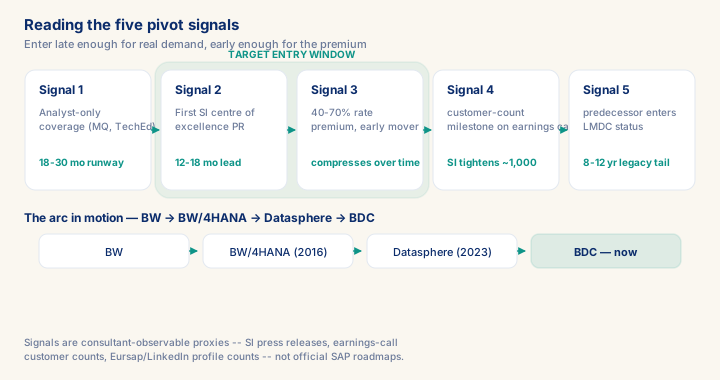
SAP's product transitions run on a 5-8 year rhythm: acquire or incubate a paradigm, coexist for 2-3 years, then gate new customers onto the winner while the old platform slides into maintenance. The decision that matters is timing. Enter a new stack too early -- as practitioners did with SAP HANA Live or Lumira Desktop -- and training hours go unbilled; enter after freelance profile counts pass roughly 500 on Eursap/LinkedIn and the 40-70% early-mover day-rate premium has already compressed to 15-25%. This module gives five observable signals -- analyst-only coverage, first SI centre-of-excellence announcements, rate-premium data, SAP earnings-call customer-count milestones, and a predecessor's move into LMDC -- to place any platform, BDC included, on that curve and decide quarter by quarter whether to train, wait, or ride the legacy tail.
What you will learn
- Identify where any SAP analytics product sits on the acquire/rebrand/sunset lifecycle arc using the five observable market signals
- Apply the BW to BW/4HANA to Datasphere to BDC case study to calibrate entry timing for the next platform wave
- Distinguish a genuine architectural pivot from a marketing rebrand to avoid misinvesting training budget
- Build a personal 20-minute weekly pivot radar using earnings calls, SI announcements, and freelance profile counts as leading indicators
The Playbook SAP Has Run Five Times
SAP's product transitions follow a rhythm so consistent you can set your career clock by it. The arc from R/3 to mySAP ERP to ECC to S/4HANA to the emerging BDC platform shows a 5-8 year cadence: acquire or internally incubate a new paradigm, run a 2-3 year co-existence period where both old and new are sold, then progressively gate new customers onto the new platform while the old one enters maintenance mode. The analytics layer has followed the same pattern: BusinessObjects (acquired 2008) ran alongside BW for years before integration; BW on HANA was the bridge; BW/4HANA became the clean successor; Datasphere has now absorbed the workload-unification story; and BDC is beginning to absorb Datasphere's data-product framing into a broader AI data control plane.
Recognising you are inside this pattern changes how you price your time and which bets to make on training.
Reading the Five Lifecycle Signals
The acquire/rebrand/sunset arc produces observable signals at each stage. Learning to read them lets you enter a skill early enough to charge premium rates but late enough that real customer demand exists.
Prerequisites
- Intermediate hands-on experience on SAP analytics projects
- Review core concepts first: C013, C022, C011
Outcomes
- Study the 5 historical SAP product transitions and their patterns.
- Identify the "analyst-only preview" signal 24-36 months before GA.
- Apply the module's core decision: When to spend training hours on an emerging SAP platform.
- Track mastery with the KPI: Signal-stage read accuracy (target: Call lands within one signal stage of the next quarter's SI/earnings-call evidence).
Full module available to members. The full module adds: the decision framework · the end-to-end scenario walkthrough · the KPI scorecard · the anti-patterns · the code blocks · the knowledge check · the diagrams.