Continuous Rate Benchmarking
As of 2026-10-03
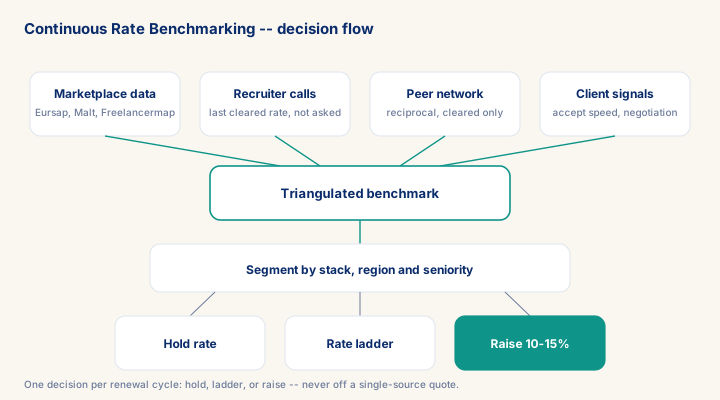
Consultants who benchmark rates informally leave 20-40% on the table during market upswings, or price above the ceiling and stretch the gaps between engagements -- and neither error is visible without structured data. Continuous Rate Benchmarking replaces gut-feel pricing with a four-channel triangulation (marketplace data, recruiter cleared-rate calls, peer network, client acceptance signals) that separates aspirational rates from what actually clears. The stack-region-seniority matrix matters more than any average: a BDC architect in Switzerland and a BW/4HANA consultant in Eastern Europe are different markets, and the delivery-to-advisory rate gap alone can run 60-80% within the same stack. The practical output is a rate ladder plus a 10-15% renewal-increment discipline -- the lever that keeps a client relationship intact where a 40% jump would trigger a competitive re-tender.
What you will learn
- Triangulate your day-rate against all four intelligence channels -- marketplace data, recruiter cleared-rate conversations, peer network, and client acceptance signals -- rather than relying on any single source
- Apply the stack-region-seniority benchmarking matrix to avoid the systematic error of averaging across fundamentally different sub-markets in the EMEA SAP analytics space
- Identify the structural conditions that signal a rate increase is justified, and apply the 10-15% increment rule to preserve client relationships while correcting under-pricing
- Frame the rate conversation as a calibration grounded in verified cleared-rate data, including the specific differentiator narrative that justifies positioning at the upper end of the range
Why Your Day-Rate Is Always Wrong
Most consultants set their day rate once, defend it instinctively, and rarely update it with structured data. The result is systematic mispricing -- either leaving 20-40% on the table during market upswings or pricing above the current demand ceiling and extending gaps between engagements. Continuous benchmarking is not about chasing the market; it is about maintaining calibration so every rate conversation is grounded in real data rather than intuition or anxiety.
The mechanics of mispricing are asymmetric. Under-pricing is invisible to you -- clients never complain that they got a bargain -- while over-pricing produces visible rejection that is easy to rationalise as bad luck or difficult clients. A structured benchmarking discipline surfaces under-pricing as clearly as over-pricing.
The Four Sources of Rate Intelligence
No single source gives you the complete picture. The discipline is triangulating across four channels.
Prerequisites
- Review core concepts first: C048, C006, C086
Outcomes
- Triangulate 5 rate sources monthly for your specialty and region.
- Build a 24-month rate history to spot your own drift.
- Apply the module's core decision: Which rate-intelligence channel to weight most heavily — choose Weight recruiter and peer-network cleared rates highest; use marketplace postings.
- Track mastery with the KPI: Rate variance vs triangulated benchmark.
Full module available to members. The full module adds: the decision framework · the end-to-end scenario walkthrough · the KPI scorecard · the anti-patterns · the knowledge check · the diagrams.