
Weak Signals: Spotting the Next Wave Early
As of 2026-11-08
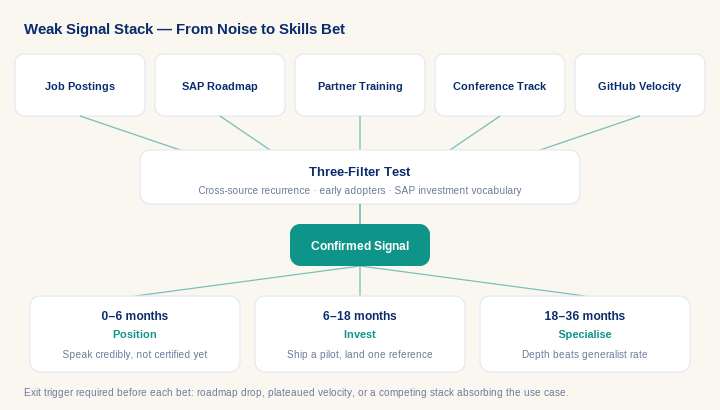
Weak Signals: Spotting the Next Wave Early is a weekly, 30-minute practice for deciding which SAP technology to bet a skill investment on before it shows up in salary surveys. Consultants who positioned on SAP Data Warehouse Cloud ahead of its March 2023 rename to Datasphere could already show delivery references while the market still treated the product as a niche play (the size of the rate advantage is not published; any figure is a practitioner estimate); consultants who waited for “Datasphere” to appear as a required LinkedIn skill entered after that rate advantage had already compressed. The module gives a five-source signal stack (job postings, SAP roadmap language, partner training catalogs, conference session mix, GitHub commit velocity), a three-filter test to separate signal from noise, and a time-horizon framework — 0–6 months positioning, 6–18 months skill investment, 18–36 months depth bet — with a mandatory exit trigger for every active bet. The deliverable is a personal watch list capped at three to five signals, because a thirty-item list is operationally the same as tracking none.
What you will learn
- Build a personal signal stack from five concrete sources — job-posting shifts, SAP roadmap language, partner training catalogs, conference tracks, and GitHub commit velocity — and check it weekly in under 30 minutes
- Distinguish a genuine weak signal from noise by applying a three-filter test: recurrence across independent sources, early adopter density, and SAP's own investment vocabulary
- Convert a confirmed signal into a skills bet with a defined time horizon, a measurable entry point, and an explicit exit trigger if the signal reverses
- Use signal findings as positioning material in client conversations before the technology becomes a generic job-posting keyword
Why signals are worth more than certifications
A dated case shows the pattern. On 8 March 2023 SAP renamed SAP Data Warehouse Cloud to SAP Datasphere, "the next generation of SAP Data Warehouse Cloud", with a new data catalog and data marketplace, and existing customers received the new functionality without migration (SAP News, 8 March 2023). Consultants who had already delivered on the former product could show references on the day the new name started to appear in postings; those who waited for "Datasphere" to become a required skill in job ads entered a market where that head start was gone. (How large the rate advantage was is not published; any figure you hear is a practitioner estimate.)
This is not about prediction — it is about systematic observation. Weak signals are concrete, observable facts that, when aggregated across independent sources, indicate where demand is building before it is visible in hire counts or salary surveys. Every senior consultant has experienced the feeling of "knowing" a technology was about to matter. This module makes that informal intuition into a repeatable weekly practice.
Prerequisites
- Intermediate hands-on experience on SAP analytics projects
- Review core concepts first: C025, C080, C060
Outcomes
- Run the five-source signal stack weekly and log one dated row per run.
- Apply the three-filter test and keep three to five confirmed signals in active monitoring.
- Apply the module's core decision: Which sources to include in your personal signal stack — choose: Run all five sources weekly in under 30 minutes using saved searches and a quarterly roadmap diff; treat any source you cannot check weekly as noise, not data; avoid: Substituting SAPPHIRE keynote buzzwords for one of the five sources — keynote language is already three layers of marketing removed from real signal.
- Track mastery with the KPI: Weekly signal-stack review time (target: Under 30 minutes, all five sources checked; red flag: Skipping the GitHub or partner-training check for more than two consecutive weeks — the two sources practitioners drop first).
Full module with the Consultant plan — €19.90/month. The full module adds: the decision framework · the end-to-end scenario walkthrough · the KPI scorecard · the anti-patterns · the code blocks · the knowledge check · the diagrams.