Program-Level Orchestration (Multi-Workstream)
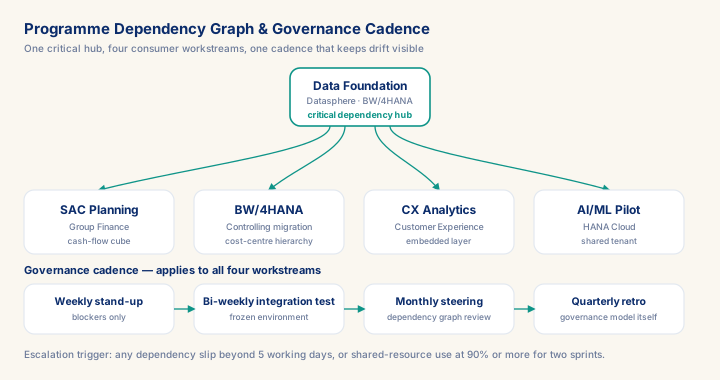
As of 2026-10-03
Running one SAP analytics project is a bounded problem; running five concurrent workstreams — Datasphere data products, an SAC Planning build, a BW/4HANA migration, an embedded CX layer, and an AI/ML pilot sharing one HANA Cloud tenant — is not the same discipline at bigger scale. The single highest-leverage decision at programme kick-off is naming the critical dependency hub: in most SAP analytics programmes it is the data-foundation workstream, and a two-week slip there typically costs four to six weeks downstream once rework and re-integration are counted. This module teaches the dependency graph, the integration-contract discipline, and the escalation triggers that stop that multiplier from compounding into a missed go-live. In EMEA, consultants who can demonstrate this — three or more concurrent workstreams, shared infrastructure, cross-domain data — bill €1,400-1,800/day as programme director, well above single-project rates.
What you will learn
- Map inter-workstream data, component, and sequencing dependencies into an explicit dependency graph and identify the critical dependency hub that carries the highest cost-of-delay multiplier
- Define integration contracts (data model versioning, shared tenant governance, authorisation model alignment) as named programme deliverables with acceptance criteria and change notification processes
- Design a programme governance cadence (weekly integration stand-up, bi-weekly integration testing cycle, monthly steering, quarterly programme retrospective) calibrated to five concurrent workstreams
- Manage shared scarce resources (senior HANA modellers, basis specialists, Datasphere architects) through a programme resource board with explicit allocation arbitration and escalation triggers
The Gap Between Project Manager and Programme Director
Managing a single SAP analytics project—say, an SAC Planning implementation for Group Finance—is a bounded problem. You have one backlog, one release train, one steering committee, one set of acceptance criteria. Managing a programme of four or five concurrent analytics workstreams—SAC Planning for Finance, Datasphere data products for Supply Chain, BW/4HANA migration for Controlling, an embedded analytics layer for Customer Experience, and an AI/ML pilot on HANA Cloud—is an entirely different discipline. The boundaries of each workstream are permeable: a delay in the Datasphere data model blocks the SAC Planning workstream because the cash-flow cube depends on a virtual table from Datasphere. The BW/4HANA migration team's decision to move cost-centre hierarchies to a flat dimension in BW breaks three SAC stories in the Customer Experience stream.
Programme-level orchestration is the set of practices that holds these interdependencies legible, manages the shared resources (SAP Basis capacity, the HANA Cloud tenant, the central SAP authorisation team, the finite pool of senior data modellers), and creates the governance cadence that surfaces integration failures before they become production defects.
Prerequisites
- Intermediate hands-on experience on SAP analytics projects
- Review core concepts first: C087, C058, C052
Outcomes
- Work through a realistic scenario: A European industrial manufacturer runs a five-workstream SAP analytics programme — SAC Planning for Group Finance, Datasphere data products for Supply Chain.
- Recognize and avoid the anti-pattern: Six workstreams, six integration test environments — Zero cross-workstream integration testing happens until the month before go-live.
- Apply the module's core decision: How granular should the dependency graph be.
- Track mastery with the KPI: Dependency slip multiplier (target: <= 1.5x on data-foundation delays; red flag: >= 3x).
Full module available to members. The full module adds: the decision framework · the end-to-end scenario walkthrough · the KPI scorecard · the anti-patterns · the knowledge check · the diagrams.