
Delivery Excellence as a Brand Moat
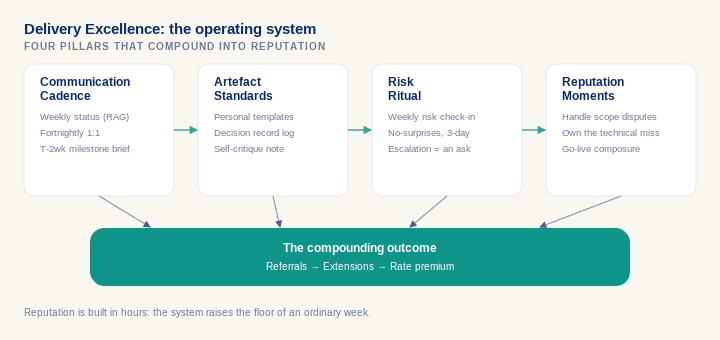
As of 2026-11-08
Delivery excellence is the difference between a consultant who gets rehired and one who gets replaced at renewal. The lever is operational, not talent: a weekly status cadence with a one-sentence rationale for every non-green item, a personal artefact template refined project over project, and a hard rule — never surface a known problem in a steering committee for the first time. Consultants who run this system convert ordinary weeks into extension-worthy weeks, and extensions are the most credible quality signal in a market too small to hide a bad reputation. The commercial payoff: rate conversations shift from a comparison against a cheaper unknown to a defensible cost of the risk removed.
What you will learn
- Design the operational systems — communication cadence, artefact standards, risk rituals — that make delivery excellence consistent rather than individual-effort-dependent
- Understand how consistent quality compounds into reputation, referral, and rate premium over a multi-year consulting career
- Identify the specific moments in a SAP programme where reputation is built or lost and manage those moments deliberately
- Apply the delivery excellence framework to position yourself as a preferred consultant — in extensions, referrals, and direct client requests
Delivery Excellence Is a System, Not a Trait
Scope: this module is global. It applies in every EMEA market, and its examples come from 6 countries (DE, FR, UK, CH, NL, BE): Germany, France, the UK, Switzerland, the Netherlands and Belgium. Nothing here depends on national law. The one place where a contract clause changes by country (the rate and substitution wording in the last chapter) is flagged there.
Consultants who deliver at a high standard year after year have not simply more talent than their peers. They run a system: a fixed weekly rhythm (one status update every 7 days), standard formats and explicit gates, so that quality is the default output of an ordinary week. Talent and energy fluctuate with project stress, and a system does not.
Prerequisites
- Intermediate hands-on experience on SAP analytics projects
- Review core concepts first: C079, C083, C058
Outcomes
- Work through a realistic scenario: A European industrial-equipment manufacturer runs a 12-month SAP Datasphere and SAC programme, with a governance-heavy steering committee and a sponsor who was burned by a previous vendor's undisclosed delays.
- Recognize and avoid the anti-pattern: Delegating status updates and risk escalations to a junior while the senior 'does the real work' — The mechanism that maintains sponsor confidence is run by the person with the least authority to be candid about bad news.
- Apply the module's core decision: How to structure the weekly status update — choose: Three fixed sections: RAG status with a one-line rationale for every non-green item, decisions needed in the next 7 days, and risks that moved this week; avoid: A narrative update with no red/amber/green line and no explicit ask.
- Track mastery with the KPI: Escalation lead time (target: >= 3 days between identifying a red/amber risk and briefing the sponsor; red flag: The sponsor hears about a risk for the first time in a steering committee).
Full module with the Consultant plan — €19.90/month. The full module adds: the decision framework · the end-to-end scenario walkthrough · the KPI scorecard · the anti-patterns · the knowledge check · the diagrams.