Financial Independence Math (FIRE)
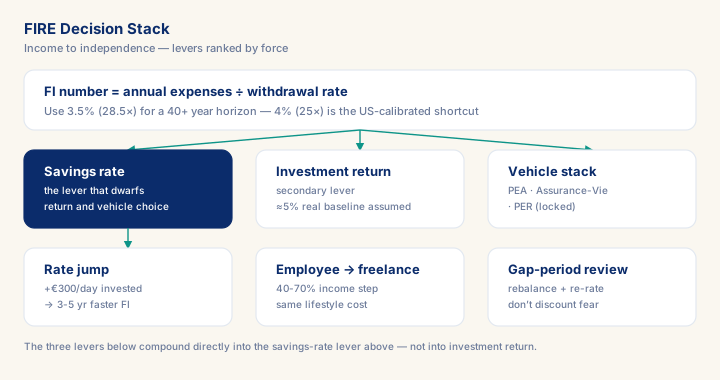
As of 2026-10-03
Financial Independence Math (FIRE) gives an EMEA SAP analytics consultant the arithmetic to convert a variable day-rate into a fixed date: at a 3.5% withdrawal rate, the target is 28.5x annual expenses, not the more aggressive 25x (4%) most FIRE content assumes. The single lever that matters most is savings rate, not investment return — a consultant saving 50% of after-tax income reaches independence in roughly 15-20 years from a standing start, before any rate jump is counted. For a France-resident freelancer, the PEA's five-year tax clock means the first action is opening the wrapper on day one, even with a EUR 500 deposit, not waiting until the money feels significant. The module's practical payoff is negotiating leverage: a consultant with ten years of runway sets a day-rate floor that a consultant with six weeks of savings cannot afford to hold.
What you will learn
- Calculate your personal FIRE number using the 3.5% withdrawal rate (28.5× annual expenses) and explain why 4% is too aggressive for a 40+ year time horizon
- Identify the correct vehicle stack for long-term equity investment as a France-resident consultant: PEA as the priority wrapper, assurance-vie for amounts above the PEA ceiling, PER for locked pre-retirement savings — and articulate why opening the PEA early matters
- Demonstrate how a single rate increase from €600/day to €900/day translates into a FIRE timeline acceleration of three to five years when the increment is invested rather than consumed
- Distinguish savings rate as the primary lever for financial independence from investment return as the secondary lever, and apply this distinction to your own income and expense figures
Why FIRE Is Unusually Accessible for SAP Analytics Consultants
Most FIRE literature is written for American software engineers earning $200k–$400k in tech company salaries. This module is written for SAP analytics consultants in EMEA — typically earning €80k–€180k/year as employees or €600–€1,200/day as freelancers — and addresses the specific vehicles, tax structures, and career patterns relevant to that audience.
The underlying mathematics of FIRE (Financial Independence, Retire Early) is not complicated. What requires discipline is understanding which version of the math applies to your situation, what honest caveats attach to the headline figures, and how to accelerate the trajectory using the specific characteristics of a consulting income — which is high, variable, and unlike a salaried tech job does not automatically include equity upside.
What follows: the core math, the France-specific investment vehicles most relevant to a high-income consultant, and the relationship between consulting career strategy and financial independence trajectory.
Prerequisites
- Intermediate hands-on experience on SAP analytics projects
- Review core concepts first: C100, C047, C097
Outcomes
- Work through a realistic scenario: A Paris-based SAP BW/4HANA freelance consultant billing EUR 850/day builds a complete personal FIRE plan over one month, without disrupting an active client engagement.
- Recognize and avoid the anti-pattern: Using the 4% / 25x rule for a 40-plus year retirement — The portfolio target is understated by roughly three to four years of expenses.
- Apply the module's core decision: Which withdrawal rate to plan on — choose 3.5% (28.5x expenses) as the working baseline for any horizon beyond 30 years; 3% (33x) if stopping active income before age 50.
- Track mastery with the KPI: Savings rate (after-tax) (target: >= 40% sustained; red flag: < 25% — the FI timeline extends past 30 years regardless of investment return).
Full module available to members. The full module adds: the decision framework · the end-to-end scenario walkthrough · the KPI scorecard · the anti-patterns · the knowledge check · the diagrams.