Building a Small Boutique (2-10 People)
As of 2026-10-03
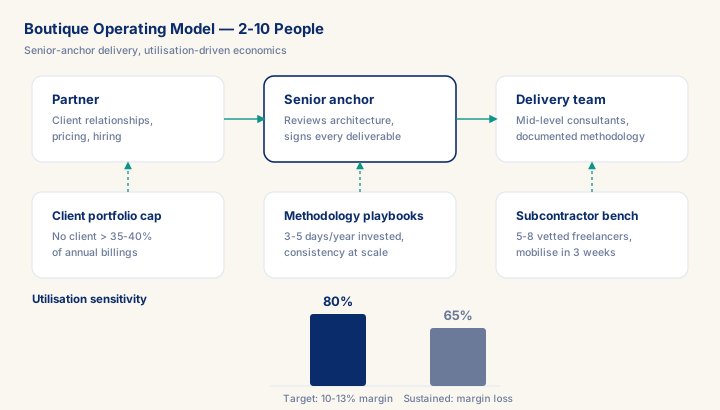
A 2-10 person SAP analytics boutique survives or fails on one number: utilisation. At an 80% target and a €950/day DACH blended rate, a 6-person firm clears roughly €900K in billings and a 10-13% margin — a margin that a single quarter at 65% utilisation turns into a loss on the same cost base. The founder's job is not to grow headcount but to defend three things at once: a senior anchor on every deliverable, a subcontractor bench that absorbs demand swings without adding fixed cost, and a client base capped at 35-40% concentration per account. Get the senior-anchor model wrong and the 15-25% rate premium over an SI collapses along with referrals; get client concentration wrong and one lost renewal becomes a cash crisis instead of a bad quarter.
What you will learn
- Diagnose the utilisation and pricing structure that makes a 2-10 person SAP analytics boutique economically viable rather than a lifestyle trap
- Design a delivery model that creates leverage without destroying the quality that justified the boutique's premium over a large SI
- Build the partner's role and the culture that retains senior people in a structure that cannot compete with large-firm salaries
- Identify the three moments when a boutique must choose between staying boutique and starting to scale — and how to decide
The Boutique's Structural Paradox
A 2-10 person SAP analytics boutique occupies a structurally uncomfortable position in the market. It is too large to have the flexibility and simplicity of a solo practice, and too small to have the bench depth, brand recognition, and bid capacity of a mid-size SI. The boutiques that survive and prosper have resolved this paradox explicitly: they compete not on scale but on the specific quality and responsiveness that only a small, senior team can deliver, and they price accordingly. The boutiques that fail have tried to compete on the SI's terms — broader coverage, lower rates, larger project bids — and have discovered that a 6-person firm cannot win that competition.
This module is about running a boutique that resolves the paradox deliberately. The economics, the delivery model, the partner's role, and the culture are all interconnected. Understanding how they interconnect — and what breaks first when you get one wrong — is the practical knowledge this module provides.
Prerequisites
- Intermediate hands-on experience on SAP analytics projects
- Review core concepts first: C087, C083, C074
Outcomes
- Work through a realistic scenario: A 5-person Vienna-based boutique is offered a €1.2M SAP Datasphere plus SAC rollout for a DACH retail group — a programme that would normally need 12-15 consultants.
- Recognize and avoid the anti-pattern: Winning a programme too large for the core team without a pre-built bench — Forces a choice between declining a won deal and staffing with unvetted freelancers.
- Apply the module's core decision: Time-and-materials vs fixed-price contract — choose Time-and-materials by default; fixed-price only when the scope is fully documented.
- Track mastery with the KPI: Utilisation rate (rolling 3-month) (target: 80% of billable capacity).
Full module available to members. The full module adds: the decision framework · the end-to-end scenario walkthrough · the KPI scorecard · the anti-patterns · the knowledge check · the diagrams.