
Creating an Online Academy
As of 2026-11-08
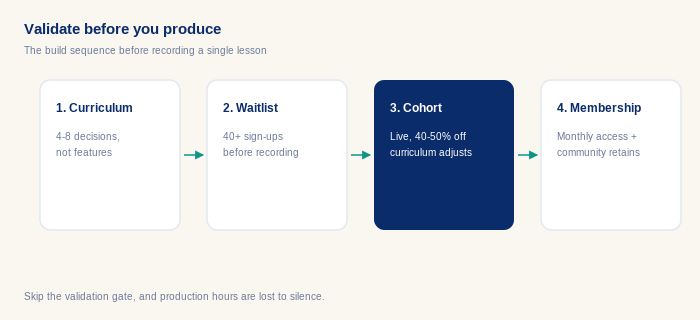
An online academy only earns its price if it teaches the decision layer SAP Learning Hub cannot: what a senior consultant actually says when the client's data model is a disaster, not another product walkthrough. The sequence that avoids launching to silence is to validate first — a 40-plus-person waitlist and a paid founder cohort before recording a single lesson — then price at the 'boundary of uncomfortable' (roughly a third of the target buyer's day-rate, not a fraction of it), and prefer a cohort or membership model over a one-time course, because the unit economics only compound if retention does. Consultants who run a credible academy also collect the most transferable career asset in the room: a visible domain authority that supports a higher rate.
What you will learn
- Design a curriculum structure that reflects genuine expertise — not a regurgitation of SAP documentation — and that learners cannot find for free on YouTube
- Choose between platform-hosted (Teachable, Podia, Maven), cohort-based (Maven) and self-hosted architectures based on your realistic student count and margin requirements
- Build a pre-launch waitlist and validate willingness to pay before recording a single lesson
- Calculate the unit economics of an online academy honestly: production cost, platform fees, card processing and refunds, and what annual revenue is actually achievable
What your academy is actually competing against
Before you build anything, answer the question every prospective student asks silently: why pay for this when SAP Help, free tutorials and a chatbot are one click away? Most consultant academies never answer it. They produce a feature walkthrough, a configuration sequence or a certification-prep track, which is structurally what SAP's own education produces, and then wonder why nobody pays. You cannot beat that at its own game.
What you can beat it at is practitioner judgment. The missing curriculum in SAP analytics education is the decision layer above the tool, the part no 90 min feature video covers. When do you recommend SAC Planning over a Datasphere-driven planning design? How do you scope a BW/4HANA migration when the client has 12 years of custom InfoProvider logic? What does a senior consultant say in the first workshop when the data model is a disaster? That layer needs real delivery experience, so it is worth paying for (see Figure 1).
Prerequisites
- Intermediate hands-on experience on SAP analytics projects
- Review core concepts first: C087, C083, C075
Outcomes
- Work through a realistic scenario: A senior SAP analytics consultant with 14 years of BW/4HANA and SAC delivery experience wants to turn hard-won practitioner judgment into a paid academy — without shadow-copying SAP Learning Hub or launching to silence.
- Recognize and avoid the anti-pattern: Depth by topic instead of depth by decision — "SAC Planning: Complete Guide" gives students no reason to choose it over SAP's own training; a narrow decision-scoped title undersells to the mass market but sells hard to the right niche.
- Apply the module's core decision: Curriculum architecture: feature tour or decision lab — choose: Structure the curriculum around 4-8 named decisions of 60-120 minutes each that only a delivery consultant can answer — e.g. 'SAC Planning vs a Datasphere-driven planning design', scoped and titled as a decision, not a feature; avoid: Mirroring SAP Learning Hub's feature walkthrough with better production values — you cannot out-produce SAP's own education division at its own game.
- Track mastery with the KPI: Waitlist conversion (target: 40+ qualified sign-ups from the posts plus 30-50 personal outreach messages; red flag: Under a 15% response rate signals the topic or the audience is not validated yet).
Full module with the Consultant plan — €19.90/month. The full module adds: the decision framework · the end-to-end scenario walkthrough · the KPI scorecard · the anti-patterns · the knowledge check · the diagrams.