GmbH, UG, or Einzelunternehmen: Choosing a Structure to Bill SAP Work in Germany
As of 2026-08-16
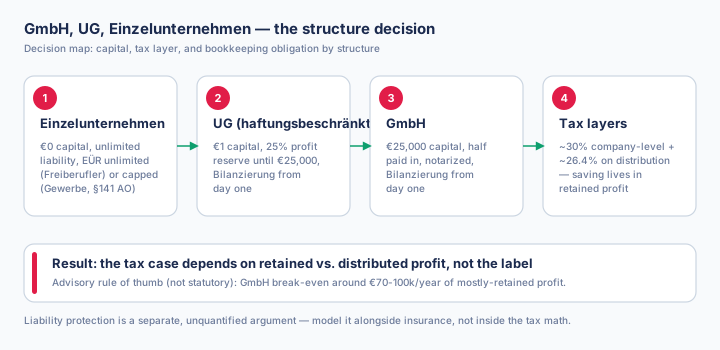
A GmbH/UG does not automatically beat direct billing as Einzelunternehmer or Freiberufler — the tax case depends almost entirely on whether profit is retained or distributed. At company level, a GmbH/UG pays roughly 15.825% Körperschaftsteuer plus Soli, plus Gewerbesteuer with no €24,500 Freibetrag, landing around 29-30% of profit at a typical 400% Hebesatz; extracting that profit as a dividend adds a further 26.375% Abgeltungsteuer plus Soli, for a combined bite that can exceed the 45% top marginal rate a Freiberufler pays directly above €277,825. The structural saving lives specifically in retained profit: roughly 30% company-level tax beats a 42-45% personal marginal rate on the same euro kept inside the business, and advisory rules of thumb (not a statutory threshold) put the GmbH's break-even around €70,000-100,000/year of mostly-retained profit. Liability protection is a separate, unquantified argument worth weighing alongside the tax math for a consultant carrying delivery risk on large SAP engagements — and a foreign, non-resident founder can legally hold the Geschäftsführer role, though remote cross-border management raises a tax-residency question that only a case-specific cross-border tax opinion can settle.
What you will learn
- Understand the legal mechanics behind choosing GmbH, UG, or Einzelunternehmen for German SAP billing
- Apply choosing GmbH, UG, or Einzelunternehmen for German SAP billing correctly to a typical German SAP engagement
- Recognize the 3-5 common mistakes and how to avoid them
- Position this compliance knowledge in client conversations and contract negotiation
Not professional advice. Choosing a legal structure changes your liability, tax bill, and administrative load for years. Confirm every figure below with a Steuerberater before incorporating — verified 2026-08 against notarial and tax-advisory sources; legal capital minimums cross-checked against §5/§5a GmbHG.
Three structures, one decision with compounding consequences
Einzelunternehmen / Freiberufler in direct name carries unlimited personal liability but zero incorporation cost — Gewerbeanmeldung or a Finanzamt declaration, no notary. UG (haftungsbeschränkt) — the "mini-GmbH" — needs only a symbolic €1 of capital (a workable amount is recommended in practice), but must retain 25% of annual profit as legal reserve until it reaches €25,000, at which point it can convert to a full GmbH. GmbH requires €25,000 minimum share capital (§5 GmbHG), at least half (€12,500) paid in at formation, a notarized founding act, and Handelsregister registration — typical all-in notary and registration costs run roughly €800-1,000 for a single-founder GmbH with a standard "Musterprotokoll" (notar-drkotz.de, va-ra.com, cross-checked 2026). Both UG and GmbH are "Kaufmann kraft Rechtsform" under §238 HGB: full double-entry bookkeeping from day one, no revenue exemption — unlike Einzelunternehmer/Freiberufler, where EÜR stays available (unlimited for Freiberufler, up to §141 AO thresholds for Gewerbe).
Prerequisites
- Complete M318 (Freiberufler vs Gewerbe) first
- Review core concepts first: C074, C068
Outcomes
- Understand the legal mechanics behind choosing GmbH, UG, or Einzelunternehmen.
- Apply choosing GmbH, UG, or Einzelunternehmen in a real German SAP engagement.
- Explain the core decision points and risk map for choosing GmbH, UG, or Einzelunternehmen.
- Apply a repeatable due-diligence pattern in a 15-minute lab format.
Full module available to members. The full module adds: the decision framework · the end-to-end scenario walkthrough · the KPI scorecard · the anti-patterns · the knowledge check · the diagrams.