The Annual Review as a Career Tool, Not a Formality
As of 2026-08-16
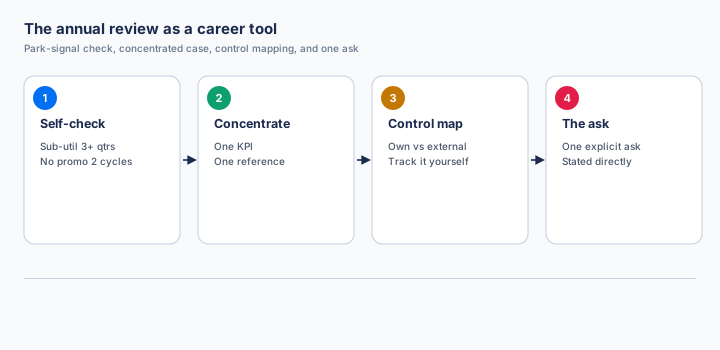
The annual review compounds comp: a Big-4 Senior Manager promoted on the firm-typical 8-10 year timeline lands at the band's p50 (~EUR160K); reached late, the same grade lands in the lower quartile (Employee Salaries study, Part X.1). Cognitive load theory explains why a one-KPI, one-reference case lands better than an exhaustive project list. The Employee Consultants study (Part VII.1) names the two-signal park pattern to check for yourself: 3+ quarters of sub-utilisation without a bench-development plan, and no promotion conversation logged for two cycles — either alone is common, both together is a signal worth surfacing directly.
What you will learn
- Explain why the annual review is a compounding comp decision, not a status update.
- Prepare a review case around one KPI and one named reference instead of an exhaustive project list.
- Read your own park signals — sub-utilisation and missing promotion conversations — before the reviewer names them.
- Apply locus-of-control thinking to the parts of a review that are genuinely within your control.
What the review is actually deciding
The Employee Salaries study (Part X.1) shows the review cycle is not a formality dressed as ceremony — it is the mechanism that compounds comp. A Big-4 Senior Manager promoted on the firm-typical 8-10 year timeline lands around the band's p50 (roughly EUR160K total cash); the same grade reached late lands EUR145-160K, the lower quartile, with a materially reduced probability of the next promotion. Firms allocate top-quartile bonus and lateral retention to consultants tracking on-pace, and the review is where "on-pace" gets decided. Walking in unprepared treats a compounding decision as a routine status update.
The two signals to bring, not one
Cognitive load theory (this platform's concept library, C096) explains why a review packed with every project detail lands worse than one built around two things: the outcome you own, and the evidence for it. A reviewer holding five vague achievements retains none of them; a reviewer holding one KPI plus one named reference retains both. Prepare the one-sentence version of your quarter before you prepare the detailed one, and lead with it.
Prerequisites
- At least one prior annual review cycle inside an SAP analytics employer.
- Review core concepts first: C096, C098.
Outcomes
- State why promotion timing itself compounds into a comp signal.
- Prepare a one-KPI, one-reference review case.
- Recognise the two-signal park-risk pattern from the Employee Consultants study.
- Distinguish the controllable parts of a review from the genuinely external ones.
Full module available to members. The full module adds: the decision framework · the end-to-end scenario walkthrough · the KPI scorecard · the anti-patterns · the knowledge check · the diagrams.