Scheinselbständigkeit: Real Criteria, Real Signals, Structuring a Mission to Avoid It
As of 2026-08-16
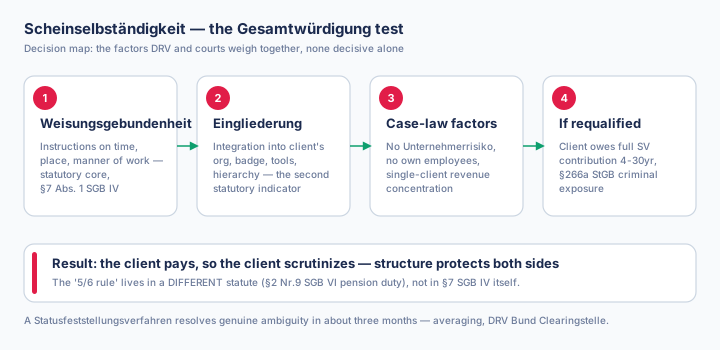
Scheinselbständigkeit exposure falls entirely on the client, not the consultant, which is exactly why German procurement teams scrutinize it — but the underlying test, §7 Abs. 1 SGB IV's Weisungsgebundenheit and Eingliederung, is often confused with a different statute, §2 Nr. 9 SGB VI's single-client pension-duty test. A requalification finding forces the client to pay the full employer-plus-employee social-security contribution retroactively, with a 4-year limitation extending to 30 years for intentional withholding, plus criminal exposure under §266a StGB up to 10 years for especially severe cases — the consultant rarely bears the direct cost, but loses the freelance relationship. The DRV Bund Clearingstelle resolves genuine ambiguity in about three months via a Statusfeststellungsverfahren that either party can request alone. The protective pattern is straightforward and mirrors risk factors directly: deliverable-based contracts, own tools and schedule, freedom to subcontract, and multiple simultaneous clients — none decisive alone, but together they build the evidence trail that a Werkvertrag-style engagement (covered in this track's contract module) makes easier to document and live day to day.
What you will learn
- Understand the legal mechanics behind Scheinselbständigkeit risk assessment and structuring
- Apply Scheinselbständigkeit risk assessment and structuring correctly to a typical German SAP engagement
- Recognize the 3-5 common mistakes and how to avoid them
- Position this compliance knowledge in client conversations and contract negotiation
Not professional advice. Scheinselbständigkeit exposure is assessed case by case (Gesamtwürdigung) by the Deutsche Rentenversicherung and the courts. This module explains the statutory test and its consequences; it does not replace a Statusfeststellungsverfahren or advice from a Fachanwalt für Sozialrecht. Verified 2026-08 against gesetze-im-internet.de and Deutsche Rentenversicherung guidance.
The statutory test — and what it does not say
§7 Abs. 1 SGB IV defines employment only by contrast to self-employment: "Anhaltspunkte für eine Beschäftigung sind eine Tätigkeit nach Weisungen und eine Eingliederung in die Arbeitsorganisation des Weisungsgebers" — instructions on how work is done (Weisungsgebundenheit) and integration into the client's work organization (Eingliederung) are the two named indicators (gesetze-im-internet.de/sgb_4/__7.html, verified 2026-08-16). Everything else — absence of Unternehmerrisiko (no capital at risk, paid regardless of outcome), no own employees, mandatory on-site presence, use of the client's tools, hierarchical supervision — is Bundessozialgericht case-law elaboration, weighed together in a Gesamtwürdigung where no single factor decides alone.
Prerequisites
- Complete M318 (Freiberufler vs Gewerbe) first
- Review core concepts first: C065, C068
Outcomes
- Understand the legal mechanics behind Scheinselbständigkeit risk assessment.
- Apply Scheinselbständigkeit risk assessment in a real German SAP engagement.
- Explain the core decision points and risk map for Scheinselbständigkeit risk assessment.
- Apply a repeatable due-diligence pattern in a 15-minute lab format.
Full module available to members. The full module adds: the decision framework · the end-to-end scenario walkthrough · the KPI scorecard · the anti-patterns · the knowledge check · the diagrams.