Umsatzsteuer and Cross-Border Invoicing: Reverse Charge, Thresholds, Mandatory Wording
As of 2026-08-16
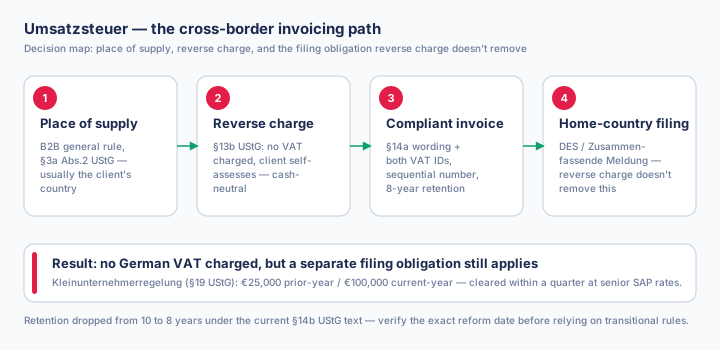
German VAT (Umsatzsteuer) sits at 19% for SAP/IT consulting, but most cross-border B2B engagements never show it on the invoice at all: §13b UStG's reverse-charge mechanism shifts the tax debt to the recipient whenever the supplier is established elsewhere in the EU, making a French-freelancer-to-German-client invoice cash-neutral and registration-free in Germany. The Kleinunternehmerregelung's current thresholds — €25,000 prior-year, €100,000 current-year turnover, confirmed directly against the reformed §19 UStG text — are arithmetic irrelevant to most senior SAP freelancers, who clear both within a single quarter of full-time billing. Invoice retention has genuinely dropped from the historic 10 years to 8 years under the current §14b UStG text, though the exact reform date and transitional back-catalogue treatment deserve a Steuerberater check before relying on them. The practical case this module builds is concrete: a French freelancer billing a German end client directly, no intermediary, owes no German VAT and needs no German VAT registration — but does owe a monthly French DES declaration from the first euro, a filing obligation reverse charge shifts nowhere.
What you will learn
- Understand the legal mechanics behind Umsatzsteuer and cross-border invoicing for SAP freelancers
- Apply Umsatzsteuer and cross-border invoicing for SAP freelancers correctly to a typical German SAP engagement
- Recognize the 3-5 common mistakes and how to avoid them
- Position this compliance knowledge in client conversations and contract negotiation
Not professional advice. VAT treatment depends on where you and your client are established and how your national tax authority applies EU rules. Confirm every figure with a Steuerberater/expert-comptable before invoicing. Verified 2026-08 against gesetze-im-internet.de (UStG), bzst.de, and douane.gouv.fr.
The rate, and why reverse charge exists
German standard VAT (Umsatzsteuer) is 19% (§12 Abs. 1 UStG) — SAP/IT consulting is a "sonstige Leistung" outside the closed 7%-reduced-rate list, so it defaults to 19%. But most cross-border B2B consulting never shows German VAT on the invoice at all: §13b UStG (Reverse-Charge-Verfahren) shifts liability for the tax to the recipient whenever the supplier is established elsewhere and the general B2B place-of-supply rule applies (§3a Abs. 2 UStG, mirroring Art. 44 of the EU VAT Directive). A French freelancer invoicing a German client charges no German VAT; the German client self-assesses and, if fully taxable, deducts the same amount as input VAT the same period — cash-neutral. Your USt-IdNr. (intra-EU VAT number), needed to trade this way, comes free from the BZSt via the "Fragebogen zur steuerlichen Erfassung" or directly online afterward.
Prerequisites
- Complete M318 (Freiberufler vs Gewerbe) first
- Review core concepts first: C068
Outcomes
- Understand the legal mechanics behind Umsatzsteuer and cross-border invoicing.
- Apply Umsatzsteuer and cross-border invoicing in a real German SAP engagement.
- Explain the core decision points and risk map for Umsatzsteuer and cross-border invoicing.
- Apply a repeatable due-diligence pattern in a 15-minute lab format.
Full module available to members. The full module adds: the decision framework · the end-to-end scenario walkthrough · the KPI scorecard · the anti-patterns · the knowledge check · the diagrams.