The German Engagement Contract: Dienstvertrag vs Werkvertrag
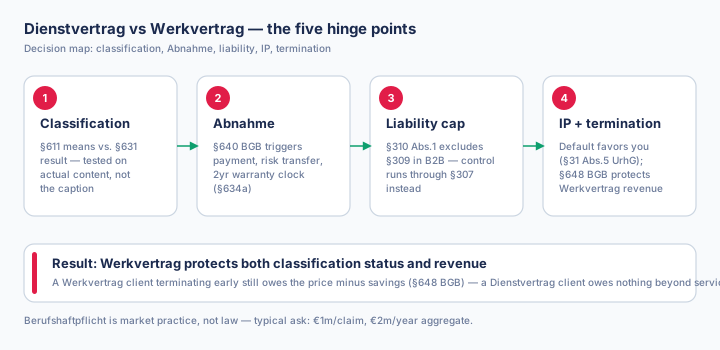
As of 2026-08-16
§611 BGB's Dienstvertrag and §631 BGB's Werkvertrag are not interchangeable labels — courts classify by the actual content of the obligation, and the choice cascades into Scheinselbständigkeit exposure, warranty periods, termination economics, and IP defaults. A Werkvertrag's Abnahme mechanism (§640 BGB) triggers payment maturity, risk transfer, and a 2-year warranty clock, with a fictitious-acceptance clause protecting the consultant against a silent client. Liability-limitation clauses are frequently reviewed against the wrong statute: §309 BGB does not directly apply to B2B contracts under §310 Abs. 1 — control runs through §307, though the practical rule survives intact: never cap liability for intent, gross negligence, or injury to life/body/health. Termination reveals the sharpest asymmetry: a Dienstvertrag client walks away owing only for services rendered, while a Werkvertrag client terminating early under §648 BGB still owes the contract price minus savings, with a statutory presumption of at least 5% retained — Werkvertrag protects both your classification and your revenue. Professional indemnity insurance is market practice, not law — typical requested coverage clusters around €1 million per claim and €2 million aggregate, a negotiated term to price into your day rate, not a legal floor.
What you will learn
- Understand the legal mechanics behind the German engagement contract — Dienstvertrag vs Werkvertrag
- Apply the German engagement contract — Dienstvertrag vs Werkvertrag correctly to a typical German SAP engagement
- Recognize the 3-5 common mistakes and how to avoid them
- Position this compliance knowledge in client conversations and contract negotiation
Not professional advice. Contract classification depends on actual performance, not the title. Have any German engagement contract reviewed by a Rechtsanwalt before signing. Verified 2026-08 against gesetze-im-internet.de (BGB).
Two obligations, not one template
§611 BGB defines Dienstvertrag as an obligation of means: you owe the promised services (Tätigkeit), paid regardless of outcome, with no statutory Abnahme. §631 BGB defines Werkvertrag as an obligation of result: the Unternehmer owes the promised Werk, explicitly including — per §631 Abs. 2 — "ein anderer durch Arbeit oder Dienstleistung herbeizuführender Erfolg," which brings custom SAP builds and migration deliverables inside Werkvertrag despite being intangible. Courts classify by the actual content of the obligation, never the caption: availability under client direction is Dienstvertrag; a defined, checkable deliverable produced autonomously is Werkvertrag.
Prerequisites
- Complete M320 (Scheinselbständigkeit) first
- Review core concepts first: C061, C062, C063
Outcomes
- Understand the legal mechanics behind the Dienstvertrag vs Werkvertrag contract choice.
- Apply the Dienstvertrag vs Werkvertrag contract choice in a real German SAP engagement.
- Explain the core decision points and risk map for the Dienstvertrag vs Werkvertrag contract choice.
- Apply a repeatable due-diligence pattern in a 15-minute lab format.
Full module available to members. The full module adds: the decision framework · the end-to-end scenario walkthrough · the KPI scorecard · the anti-patterns · the knowledge check · the diagrams.