The 30-Second Elevator Pitch for SAP Consultants
As of 2026-10-06
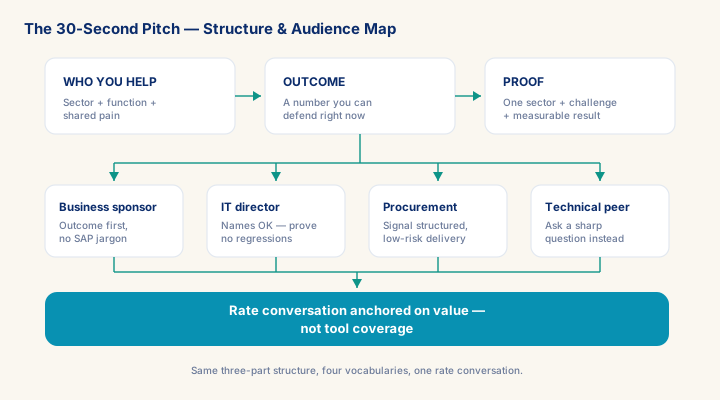
Every day-rate negotiation for an independent SAP analytics consultant starts before the client sees a number — it starts in the first thirty seconds of an introduction. Most consultants describe their tools and years of experience; the buyer only remembers the one who names a business outcome and backs it with one concrete proof, in roughly seventy spoken words. That three-part structure — who you help, the outcome, the proof — has to shift vocabulary across four buyer types, from business sponsor to technical peer. Consultants who pitch on outcome anchor the later rate conversation at value; consultants who pitch on tool coverage get compared line-by-line against the next bidder who ticks the same boxes. This module is the fifteen-minute rehearsal that decides which of those two conversations you have.
What you will learn
- Construct a 30-second pitch that leads with a specific business outcome and closes with a one-sentence proof, tailored to your actual specialism (BW/4HANA, Datasphere, SAC, or BDC)
- Identify the three most common pitch-killing patterns — credential lists, acronym overload, and hedged outcomes — and eliminate them from your current introduction
- Adapt the same core pitch structure for four distinct audience types: business sponsor, IT director, procurement manager, and technical peer
- Use pitch vocabulary strategically to anchor rate conversations at value level rather than tool-coverage level
Why Most SAP Consultants Are Forgettable
You have thirty seconds. A procurement director sits across from you at a networking dinner, or picks up the phone between meetings, or gives you the first slot of a vendor day. She works with four SAP integrators already. She is not waiting to be impressed. She is waiting to find a reason to stop listening.
Most SAP analytics consultants waste those thirty seconds. They say something like: "I work with SAP BI tools — BW, SAC, that kind of thing — and I've been doing it about twelve years." The director nods, says «interesting», and turns to someone else. The consultant did not fail because their experience is thin. They failed because they described their inputs — skills, years, tools — instead of the output the director actually cares about: what changes for her company when she works with you.
An elevator pitch is not a CV summary. It is a single, clear answer to the question the buyer is silently asking: «Why should I care about you, right now, given what I'm trying to solve?"
Prerequisites
- Review core concepts first: C086, C015, C008
Outcomes
- Write three versions of your pitch: 15s, 30s, and 60s.
- Translate technical work into business outcomes (revenue, cost, risk).
- Apply the module's core decision: How much SAP product jargon to use — choose Drop product names for business sponsors and speak in their metrics (close cycle, margin visibility, headcount-to-output).
- Track mastery with the KPI: Pitch length (target: ≤ 70 words, delivered in 30 seconds; red flag: Needs 90+ seconds to land — it has become a monologue, not a pitch).
Full module available to members. The full module adds: the decision framework · the end-to-end scenario walkthrough · the KPI scorecard · the anti-patterns · the knowledge check · the diagrams.