Objection Handling: The 10 Classic SAP Objections
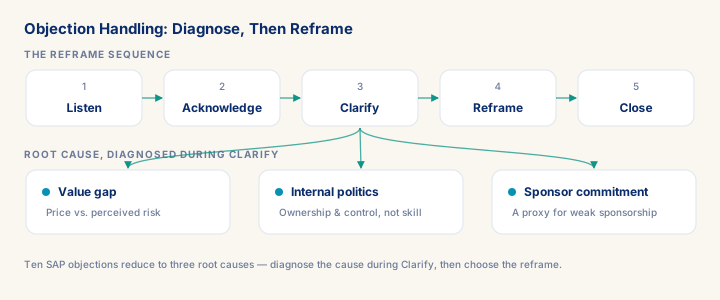
As of 2026-10-10
A stated objection is rarely the real one: "it is too expensive" usually means an unclear risk-versus-value ratio, and "our team can do this" usually means an unresolved ownership question. This module gives consultants a four-step sequence — listen, acknowledge, clarify, reframe — for the ten objections that recur most often in EMEA SAP analytics deals, from Datasphere scoping calls to SAC rollout decisions. The tell that separates a Legend from a junior: three sequential objections in one call (timing, internal team, price) are one negotiating position, not three separate concerns, and naming that pattern out loud is what moves the deal forward. Miss it, and a real, winnable engagement stalls in objection loops that never reach a commercial conversation.
What you will learn
- Identify which of the three meta-categories — perceived value gap, internal politics, or sponsor weakness — underlies each of the 10 standard SAP analytics objections before formulating any response
- Apply the acknowledge-clarify-reframe sequence to objections about price, internal capability, and product maturity without becoming defensive or resorting to feature comparisons
- Construct a specific, named-evidence reframe for the Datasphere-is-too-new and bad-prior-experience objections that builds trust rather than minimising the concern
- Recognise when a client is raising sequential objections as a negotiating pattern and convert the series of deflections into a structured thirty-minute scope-and-commercial conversation
Why Objections in SAP Analytics Are Not What They Sound Like
An objection in an SAP analytics deal is almost never the real issue stated on its face. "It is too expensive" is rarely about the absolute number — it is usually about the ratio between perceived risk and perceived value. "Our internal team can do it" is rarely about capability — it is usually about ownership and politics. "The timing is bad" is rarely about the calendar — it is usually about a sponsor who is not yet committed. Understanding this meta-layer is what separates consultants who handle objections from consultants who simply respond to them.
The structure for every objection: Listen fully. Acknowledge before responding. Clarify whether you are dealing with the stated objection or the real one. Then reframe with specificity — not platitudes. The ten objections below are the ones that recur most frequently in EMEA SAP analytics engagements, from Datasphere scoping conversations to SAC enterprise rollouts to BW/4HANA migration decisions.
Objection 1: "It Is Too Expensive"
The reframe: This objection conflates absolute price with relative value. The correct response is never a justification of your price — it is a reframe of the comparison basis.
Prerequisites
- Review core concepts first: C015, C048, C098
Outcomes
- Apply the LAER framework (Listen-Acknowledge-Explore-Respond).
- Master scripted responses to the 10 most common SAP objections.
- Apply the module's core decision: Which objection type are you actually facing.
- Track mastery with the KPI: Objection-to-next-step conversion.
Full module available to members. The full module adds: the decision framework · the end-to-end scenario walkthrough · the KPI scorecard · the anti-patterns · the knowledge check · the diagrams.