Competitive Analysis: Know Your Market Position
As of 2026-10-03
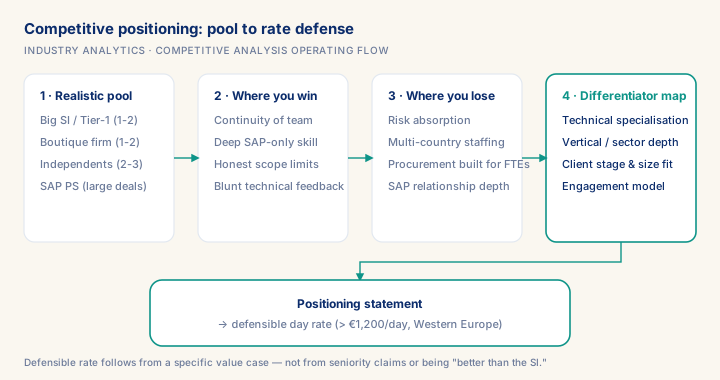
Every mid-market SAP analytics deal has a real, short competitive set — typically one or two Big Four or Tier-1 SI teams, one or two boutique firms, and two or three other independents — not "everyone who knows SAP." The decision that matters is which three or four of those competitors you are actually up against on a given €500k–€3m mandate, because your pitch, scope, and rate defense change with the answer. Independents win on continuity, SAP-specific depth, honest scope, and blunt feedback; they lose on risk absorption, multi-country staffing, and procurement processes built for headcount rather than a statement of work. Get the positioning right and an independent day rate above €1,200 in Western Europe is defensible with a specific value case — get it wrong and the same rate reads as overpriced.
What you will learn
- Map your actual market position against SI firms, other freelancers, and SAP itself using a structured differentiator analysis rather than generic claims
- Identify the specific client situations where your profile wins, where it loses, and why — so you can stop chasing unwinnable bids and focus effort where you have real leverage
- Build an honest capability map that surfaces gaps before a client conversation does, and develop a credible narrative for each gap
- Apply competitive positioning to proposal language, rate calibration, and partner sourcing decisions to convert market understanding into tangible earnings impact
The market you are actually competing in
Most SAP analytics consultants describe their competitive landscape as everyone else who knows SAP. That framing is both too broad and too narrow. Too broad because the actual shortlist for any given engagement rarely includes more than four or five realistic alternatives. Too narrow because the most important competitor on many engagements is not another person or firm — it is the client's internal team, the platform vendor's professional services arm, or the structured payment model of a staffing agency that lets the client avoid the perceived risk of a day-rate freelance engagement.
The first step in competitive analysis is defining the pool realistically, not theoretically. For a senior SAP analytics freelance consultant in Western Europe, the realistic competitive set on any mid-market engagement (€500k–€3m implementation budget) is: one or two Big Four or Tier-1 SI teams, one or two boutique SAP analytics firms, and two or three other independent consultants or small partnerships. SAP's own services arm enters the picture primarily on large-scale transformation programmes or when the account executive pushes it.
Knowing that pool means you can prepare for each type of competitor specifically, rather than positioning generically.
Prerequisites
- Review core concepts first: C047, C083, C014
Outcomes
- Map your top 20 real competitors in a structured matrix.
- Track their positioning shifts each quarter.
- Apply the module's core decision: Which competitor set to prepare against — choose Prepare specifically for the 3-4 realistic alternatives on this deal.
- Track mastery with the KPI: Competitive win rate on shortlisted bids (target: >= 40% of deals where you reach the final shortlist; red flag: Winning only on price or referral, never on a stated differentiator).
Full module available to members. The full module adds: the decision framework · the end-to-end scenario walkthrough · the KPI scorecard · the anti-patterns · the knowledge check · the diagrams.