Publishing Your Own Market Analysis
As of 2026-10-03
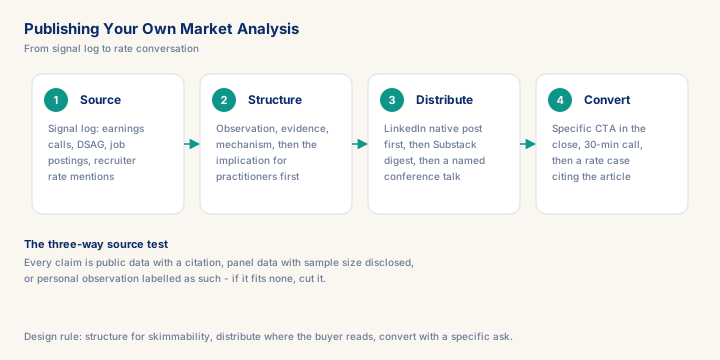
Most SAP consultants publish either product tutorials or career advice online — both crowded. Original market analysis (rate trends, the ~4,000 MEE customers still running BW on HANA or BW 7.5 per the 2026 DSAG Investitionsreport, BDC adoption pace) is nearly unclaimed territory, and a published point of view routinely supports a 10-20% rate premium over a comparable consultant with no public profile. This module is the operating discipline behind that outcome: source every claim as public data, disclosed panel data, or labelled personal observation — never blend them; structure so the implication for practitioners lands before the evidence; and close with a specific, low-commitment call to action instead of a pitch. Success is not measured in followers — it is whether a recruiter opens a client conversation with your article instead of your CV.
What you will learn
- Source and structure original market analysis using verifiable data from SAP earnings calls, DSAG surveys, and recruiter rate disclosures
- Choose publication formats and distribution channels that match your positioning as an SAP analytics specialist
- Convert a published analysis into inbound pipeline by attaching a clear point of view and a relevant call to action
- Maintain editorial credibility by separating proprietary observation from public data and disclosing methodology
Why an SAP analytics consultant should publish market analysis
Most SAP consultants who publish content online write either product tutorials or career advice. Both are crowded and commoditised. Market analysis — rate trends, skill demand shifts, SAP roadmap reads tied to real customer decisions — is almost entirely absent from the consultant-authored content landscape. That gap is your opportunity.
When you publish a credible analysis of, say, BW/4HANA migration velocity in MEE midmarket accounts, three things happen simultaneously. Recruiters and programme managers bookmark it and think of you when a relevant engagement opens. Prospects at companies facing that migration recognise a peer, not a vendor. And your own thinking sharpens because you had to defend a position publicly rather than repeat comfortable opinions internally.
This module is about building that practice: where to source data honestly, how to structure an analysis that holds up to scrutiny, how to distribute it efficiently, and how to connect it to actual commercial conversations.
Prerequisites
- Review core concepts first: C077, C038, C021
Outcomes
- Commit to a publication cadence: quarterly deep-dive, monthly article, weekly short.
- Choose a distribution channel aligned with your audience (LinkedIn, Substack, own site).
- Apply the module's core decision: Which distribution channel to launch on first — choose Publish natively on LinkedIn first — a 900-1,200 word article indexes on Google, circulates in-feed for 48-72 hours.
- Track mastery with the KPI: Publication cadence held (target: At least one substantive piece per month; red flag: Two consecutive months with zero publications — the practice has stopped compounding).
Full module available to members. The full module adds: the decision framework · the end-to-end scenario walkthrough · the KPI scorecard · the anti-patterns · the knowledge check · the diagrams.