C. V.: Tactical Empathy & the Mirror
As of 2026-10-03
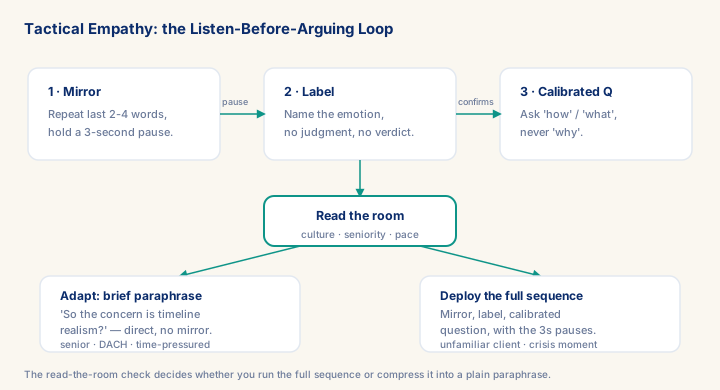
C. V.'s three tools — mirroring, labelling, and calibrated 'how/what' questions — turn a defensive client conversation into an information-gathering one, without the client feeling negotiated with. The FBI's 24-year hostage-negotiation programme behind them treats listening as leverage: a mirrored phrase or a named emotion routinely surfaces the real blocker (a missing Basis sign-off, a political risk, a budget constraint) in seconds, where an argued position takes a full meeting. The stakes are commercial as much as relational: consultants who ask more and assert less in a rate or scope conversation reliably extract the client's actual constraint before naming a number, which is the difference between negotiating from information and negotiating from hope. The catch is cultural — mirroring reads as slow in formal DACH settings and as scripted to senior partners who recognise the technique — so the real skill is knowing when to run the tool as designed and when to compress it into a plain paraphrase.
What you will learn
- Apply mirroring and labelling to keep client conversations open when they become defensive or emotionally charged
- Use calibrated questions — starting with 'how' and 'what' — to move a stalled discussion without triggering resistance
- Recognise the limits of Never-Split-the-Difference tactics in high-context European consulting relationships
- Integrate tactical empathy into a professional consulting style without it feeling manipulative or scripted
The source: hostage negotiation adapted for business
C. V. spent 24 years as a hostage negotiator for the FBI and led the agency's international kidnapping negotiations unit. His 2016 book Never Split the Difference distilled that experience into a set of practical tools. The core thesis is: in high-stakes, emotionally charged conversations, pure rationality fails because people are not rational. They respond to feeling heard before they respond to logic.
For SAP analytics consultants, the application is not hostage negotiation — but the emotional dynamics are analogous in certain moments: a steering committee where the programme is being questioned, a client who has lost trust in the delivery team after a data quality incident, a performance review where the extension decision is genuinely uncertain, or a rate conversation where the other side is signalling discomfort without stating a clear position. In each of these, the technique of listening before arguing has more leverage than the best-prepared slide deck.
Three tools — mirroring, labelling, and calibrated questions — are the core here, with an honest about where they work and where they do not.
Prerequisites
- Intermediate hands-on experience on SAP analytics projects
- Review core concepts first: C083, C079, C058
Outcomes
- Work through a realistic scenario: A mid-size European retail group's BW/4HANA migration corrupts the cost-centre hierarchy days before period-end close.
- Recognize and avoid the anti-pattern: Over-mirroring every response — The conversation turns into a strange echo chamber instead of progressing — the client notices and the technique loses credibility.
- Apply the module's core decision: Which tool to reach for first in a charged moment — choose Open with a mirror on the last few words to invite elaboration; switch to a label once an emotion is visible.
- Track mastery with the KPI: Question-to-statement ratio in charged exchanges.
Full module available to members. The full module adds: the decision framework · the end-to-end scenario walkthrough · the KPI scorecard · the anti-patterns · the knowledge check · the diagrams.