Conflict: The 5 Modes (Thomas-Kilmann)
As of 2026-10-03
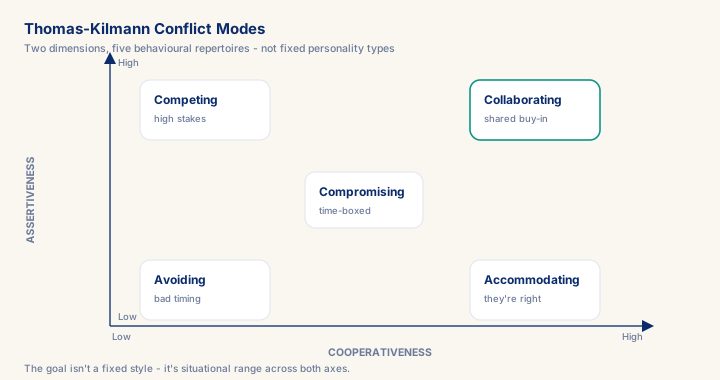
Conflict is not a communication failure to smooth over — on SAP programmes it is structural, because someone's system, data ownership, or job is genuinely at stake. The Thomas-Kilmann model names five real behavioural options — competing, collaborating, compromising, avoiding, accommodating — mapped on assertiveness and cooperativeness, and the senior-consultant skill is choosing deliberately rather than defaulting to the mode that got you promoted. Naming the mode you and your counterpart are actually in, and switching by design rather than under pressure, is a competency clients read as programme-risk management, not soft skill — and it is one of the differentiators consultants use to justify billing at the top of their range rather than the bottom.
What you will learn
- Apply the five Thomas-Kilmann conflict modes with situational judgement appropriate to SAP project contexts
- Diagnose which conflict mode a counterpart is using and select a complementary or corrective response
- Shift consciously between modes as the nature of a conflict changes within a single engagement
- Build a personal conflict-mode profile that identifies your defaults and the modes you underuse
Why Conflict Mode Matters in SAP Consulting
Conflict is structural in SAP projects. The nature of the work — redesigning business processes, changing data ownership, reallocating reporting authority, deciding which legacy system to retire — creates genuine competing interests. A Datasphere migration means someone's existing data warehouse is going away. A SAC planning module rollout means the FP&A team's Excel-based process is ending. These are not misunderstandings that good communication dissolves; they are real conflicts between real interests.
The Thomas-Kilmann Conflict Mode Instrument (TKI), developed in the 1970s and validated extensively since, describes behaviour in conflict situations along two dimensions: assertiveness (how much you pursue your own concerns) and cooperativeness (how much you accommodate the other party's concerns). The five resulting modes — competing, collaborating, compromising, avoiding, and accommodating — are not personality types. They are behavioural repertoires. The goal is not to find your "type" and stay there; it is to expand your range and exercise situational judgment about which mode fits which moment.
Prerequisites
- Review core concepts first: C083, C079, C058
Outcomes
- Work through a realistic scenario: A European industrial group is replacing its FP&A team's Excel-based planning process with SAP Analytics Cloud.
- Recognize and avoid the anti-pattern: Treating your default mode as a virtue — A consultant who always competes calls it 'high standards'; one who always accommodates calls it 'client-centric'.
- Apply the module's core decision: Client insists on a technically wrong architecture decision — choose Compete: state the risk plainly, put the disagreement in writing.
- Track mastery with the KPI: Mode-match rate (target: Chosen mode fits the situation's stakes, time pressure, and relationship value in at least 8 of 10 logged conflict moments).
Full module available to members. The full module adds: the decision framework · the end-to-end scenario walkthrough · the KPI scorecard · the anti-patterns · the knowledge check · the diagrams.