Organizational Politics: Reading the Real Org Chart
As of 2026-10-03
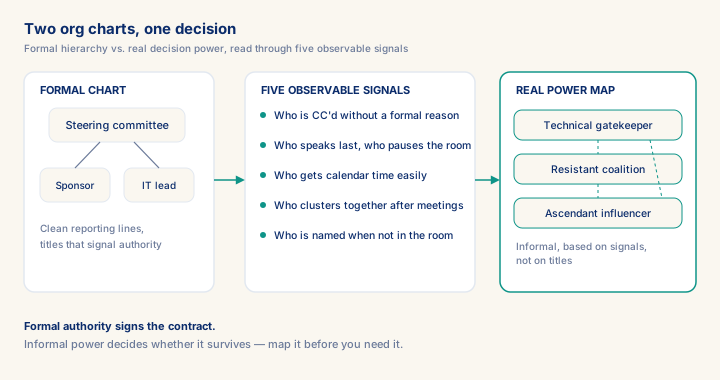
A client's org chart tells you who holds the title; it rarely tells you who can kill your recommendation with one comment in a corridor. This module trains the habit senior consultants rely on: reading CC patterns, meeting silences, calendar access, and physical clustering to find the real decision-makers, veto-holders, and resistant coalitions the formal hierarchy hides. The stakes are concrete — a veto that never appears in the RACI, a sponsor who signs the contract but not the belief, a technical gatekeeper who can quietly stall your roadmap. Consultants who can name this dynamic to a client, specifically, are demonstrating a distinct competency — one that belongs in the rate conversation at €900-1,300/day and above, not just in the delivery.
What you will learn
- Map informal power structures on a client engagement using observable behavioural signals rather than org-chart assumptions
- Identify the key structural gaps between formal authority and real decision-making influence — sponsors without conviction, technical gatekeepers, resistant coalitions
- Navigate politically complex environments ethically, using power intelligence to communicate more effectively rather than to manipulate or bypass stakeholders
- Articulate organizational navigation as a distinct professional competency in positioning and rate discussions at senior levels
The Two Org Charts Every Consultant Ignores at Their Peril
Every client engagement comes with an org chart. The one in the PowerPoint deck — neat boxes, clean reporting lines, titles that signal authority. And then there is the real one: an invisible map of who actually decides what, who needs to be satisfied before a decision gets made, who can kill your project with a lukewarm comment in a corridor, and who is chronically underestimated on paper but listened to in every room they enter.
New consultants spend their first weeks mapping the formal hierarchy. Senior consultants spend those same weeks mapping the informal power structure. This module is about closing that gap fast.
Signals That Reveal the Real Map
Who is CC'd on emails they don't need to be CC'd on? When the CIO copies someone who has no formal role in the scope of the meeting, that person matters. Watch for the habitual CC. It signals either political protection ("I need this person informed so they can't claim surprise later") or genuine deference ("this person's opinion shapes mine").
Prerequisites
- Intermediate hands-on experience on SAP analytics projects
- Review core concepts first: C083, C084, C079
Outcomes
- Work through a realistic scenario: A senior consultant joins a Joule/AI-readiness program at a European utility three weeks after kickoff.
- Recognize and avoid the anti-pattern: Single-channel intelligence — Your entire read of the room comes from one sponsor's political lens, so resistance they didn't see — or didn't disclose.
- Apply the module's core decision: How to treat a repeated, formally unnecessary CC on emails — choose Treat a cross-topic, repeated CC as a real power signal and route your next update to that person too.
- Track mastery with the KPI: Power-map accuracy (target: Every mid-engagement decision reversal traces back to a person already on the map).
Full module available to members. The full module adds: the decision framework · the end-to-end scenario walkthrough · the KPI scorecard · the anti-patterns · the knowledge check · the diagrams.