Knowledge Transfer That Actually Sticks
As of 2026-10-10
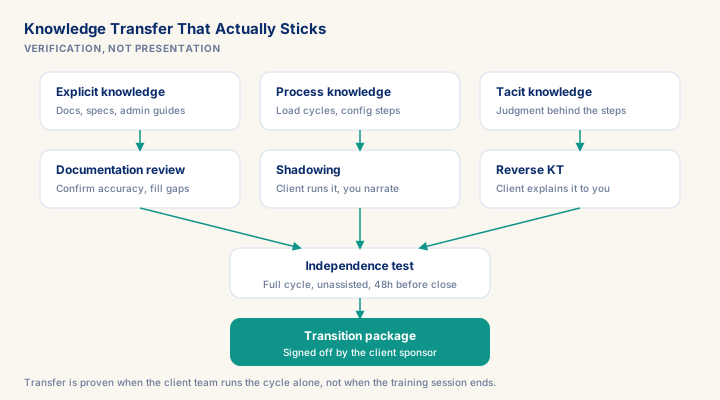
Knowledge Transfer That Actually Sticks reframes KT close-out from a training deliverable into a verification exercise: the client team must demonstrably run the solution alone, not just have watched someone else run it. The decision that matters is sequencing — shadowing needs at least one live operational cycle before the engagement ends, so it has to start weeks before hypercare, not during the final week. The proof point is the independence test: a full end-to-end cycle, unassisted, 48 hours before sign-off. Consultants who build this discipline into every close-out are the ones clients call back for the next mandate, because their engagements do not leave a dependent support tail behind.
What you will learn
- Inventory explicit, process, and tacit knowledge on an SAP analytics engagement before designing the KT programme, and identify the tacit knowledge gaps that structured documentation will not surface
- Run a shadowing programme in which the client team operates each procedure under consultant observation, using live failure events to surface and document tacit knowledge that would not appear in any training material
- Conduct a reverse KT session in which key users explain the solution back to the consultant, use the output to build a gap list, and close every item before engagement sign-off
- Produce a transition package with numbered operating procedures tested by a client team member, a troubleshooting section for the three most common failure modes, and a named documentation owner responsible for keeping it current
Why Knowledge Transfer Fails at the Finish Line
Most analytics knowledge transfer sessions fail the same way: the consultant presents, the client team watches, and both parties leave convinced that transfer happened. Six weeks later, the client's analyst cannot build a new story in SAC because the training covered what the consultant built, not how to build. The reconciliation procedure the consultant ran every Monday morning is not written down anywhere. The three Datasphere transformation rules that handle edge cases in the FX conversion are not in any document, because the consultant did not realise they were implicit knowledge.
Knowledge transfer that actually sticks is built on a different premise: the goal is not to present information, but to verify that the client team can operate without you. That verification requires structured repetition, direct observation, and a formal handover that the client team owns, not the consultant.
What You Are Actually Transferring
Before designing a KT programme, inventory what actually needs to transfer—not what is in the project deliverable list.
On a mature SAP analytics engagement, knowledge falls into three categories:
Prerequisites
- Review core concepts first: C058, C047, C087
Outcomes
- Work through a realistic scenario: A European industrial manufacturer is six weeks from the end of hypercare on a BW/4HANA reporting and SAC planning rollout.
- Recognize and avoid the anti-pattern: Treating silence as understanding — The trainer assumes no questions means the skill transferred; the client team discovers the gap in production, unsupervised.
- Apply the module's core decision: How to sequence shadowing vs documentation — choose Shadow every procedure that has one real cycle left in the schedule; document-and-simulate the ones that do not.
- Track mastery with the KPI: Shadowing coverage (target: 100% of recurring procedures run by the client team before hypercare starts).
Full module available to members. The full module adds: the decision framework · the end-to-end scenario walkthrough · the KPI scorecard · the anti-patterns · the knowledge check · the diagrams.