The Sabbatical: Structured Pauses
As of 2026-10-03
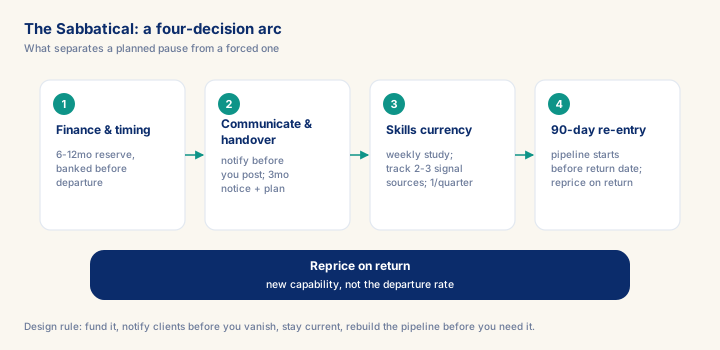
Nearly every senior SAP consultant considers a sabbatical; almost none plans one properly, and the failure mode is expensive: a burnout-triggered stoppage, or an indefinite "next year" that never arrives. Done right, a structured pause costs roughly €24,000-48,000 in pre-built reserves for six months, is timed to land right after a high-fee engagement closes, and is protected by a 90-day re-entry pipeline started before the pause ends. The number that matters is the re-entry rate: consultants who plan the financing and keep one weekly study block during the pause come back pricing a new capability, not apologising for an absence.
What you will learn
- Calculate the full financial requirement for a sabbatical — income replacement, operating costs, tax implications — and identify the timing lever that makes it viable without structural financial change
- Design a client communication plan that preserves relationships and professional reputation before, during, and on return from a structured pause
- Build a minimum-viable skills maintenance plan for the pause duration that prevents a full reskilling requirement on re-entry
- Construct a ninety-day re-entry pipeline strategy, including narrative positioning and rate reassessment, that converts a sabbatical into a career accelerator
Why Sabbaticals Exist and Why Consultants Avoid Them
The sabbatical is the career move that almost every senior SAP consultant contemplates and almost none plans properly. The word is spoken loosely — "I need a break," "I might take six months off" — but the mechanics of actually doing it as a self-employed independent are almost never discussed in professional networks where busyness is a status signal. The result is that sabbaticals happen in two dysfunctional forms: the unplanned collapse (a consultant burns out, loses a client, or faces a health event and stops working by necessity) or the indefinite deferral (the consultant keeps saying next year and retires without having taken one).
This module treats the sabbatical as a deliberate career tool — one that requires the same planning rigour as a new engagement, and one that, done well, produces measurable professional returns.
Prerequisites
- Intermediate hands-on experience on SAP analytics projects
- Review core concepts first: C047, C100, C097
Outcomes
- Work through a realistic scenario: A senior SAP consultant in France comes off a 12-month Datasphere programme for a retail-sector client at a strong day rate.
- Recognize and avoid the anti-pattern: No fixed end date ("I'll see how it goes") — Re-entry planning has nothing to anchor to, and the pause destabilises rather than restores.
- Apply the module's core decision: How long should the pause be? — choose Three months for a recovery pause, six months for a full reskill.
- Track mastery with the KPI: Financial runway coverage (target: 100% of the planned pause duration funded before departure).
Full module available to members. The full module adds: the decision framework · the end-to-end scenario walkthrough · the KPI scorecard · the anti-patterns · the knowledge check · the diagrams.