
Mentoring Junior Consultants as Legacy
As of 2026-11-07
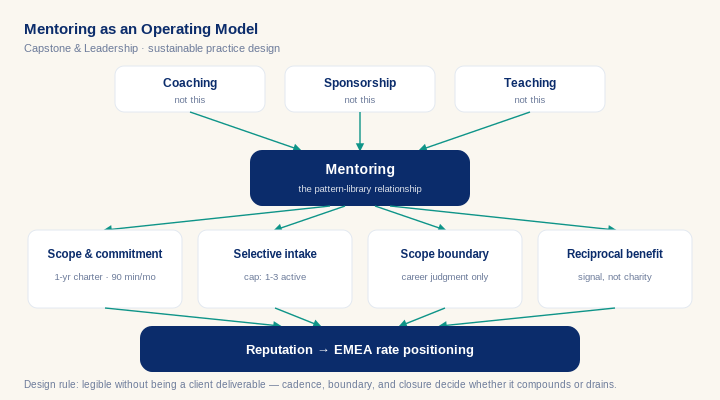
Mentoring keeps compounding after the technical knowledge behind it has aged. Treated as unstructured coffee chats, it either evaporates or becomes unpaid consulting for a competitor's staff, so the module gives an operating model: the four roles (mentoring, coaching, sponsorship, teaching), a fixed 90-minute monthly session (a 60-minute five-step core plus reciprocity time), one to three mentees at most, and a cross-firm confidentiality check for the EU, Germany and the UK (Switzerland and others marked not verified). It uses current evidence: a Stanford revision showing 22-25 year-olds in highly AI-exposed jobs about 19% below peers as of June 2026, with experienced workers in tacit-knowledge jobs gaining, and Eurostat youth unemployment for September 2026 by country. The module gives no day-rate premium for mentoring, because none is sourced.
What you will learn
- Distinguish mentoring from coaching, sponsorship, and teaching — and define the sustainable format (scope, frequency, duration) for a senior SAP analytics consultant with an active delivery practice
- Apply a pattern-library approach to mentoring sessions: surface situations, identify unseen patterns, share decision logic from experience, and close with junior-owned action rather than prescription
- Design a mentoring practice with explicit intake criteria, scope boundaries, and reciprocal benefit that sustains quality across one to three active relationships without consuming billable capacity
- Articulate how a visible mentoring practice builds long-term professional reputation and network compounding in the EMEA SAP analytics market, and connect it to senior-level rate positioning
Why mentoring is the highest-leverage unbilled hour
Mentoring junior consultants is the highest-leverage activity open to a senior SAP analytics consultant that never appears on a client invoice. It is also the most underused, for understandable reasons: it takes hours you could bill, the return is slow, and juniors sit in other firms, protected by their employers. Measure what it costs you before you start: 90 minutes a month is 18 hours a year for one mentee (example), which at your billing rate is a number you can write down.
The evidence for the junior's side is real but modest. A meta-analysis of mentoring and protégé outcomes (Allen, Eby, Poteet, Lentz and Lima, Journal of Applied Psychology, 2004) found generally supportive benefits, with small effect sizes for objective outcomes such as pay, and differences between career-focused and psychosocial mentoring (abstract on Europe PMC). Do not promise a mentee a promotion; promise a sharper decision log and fewer avoidable mistakes.
Prerequisites
- Intermediate hands-on experience on SAP analytics projects
- Review core concepts first: C047, C100, C097
Outcomes
- Work through a realistic scenario: An independent SAP analytics consultant with sixteen years' experience, mid-way through a live Datasphere programme for a European industrial group, decides to formalise a mentoring practice instead of continuing ad-hoc coffee chats with juniors who reach out on LinkedIn.
- Recognize and avoid the anti-pattern: Mentoring only juniors at your own current or former firm — The network asset stays narrow, and the relationship can read as succession politics rather than professional development.
- Apply the module's core decision: How many mentees to take on — choose: Cap active relationships at one to three, selected for self-direction — mentees who arrive having tried something, not waiting to be told; avoid: Accepting every request out of guilt or flattery; five simultaneous mentees means none of them get real attention.
- Track mastery with the KPI: Active mentoring load (target: 1-3 concurrent mentees; red flag: More than 3 concurrent mentees, or a pattern of accepting requests 'out of guilt' — depth drops across all of them).
Full module with the Consultant plan — €19.90/month. The full module adds: the decision framework · the end-to-end scenario walkthrough · the KPI scorecard · the anti-patterns · the knowledge check · the diagrams.