Strategic Partnerships (Co-Selling)
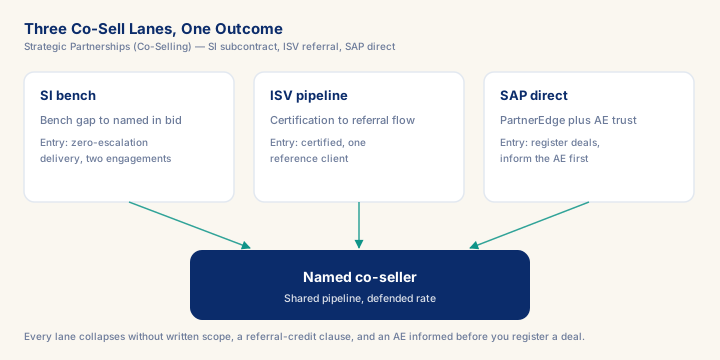
As of 2026-10-03
Co-selling only pays off when a boutique moves from anonymous subcontractor to named partner — the whole commercial case rests on that one transition. A tier-1 integrator typically marks up subcontracted delivery 15-30%, so a boutique billing at a €1,440/day floor against an €1,800/day client rate is defending margin from day one, not after the relationship matures. The decision that matters in week one is not which partner to court, but which of the three co-sell lanes — SI bench, ISV referral pipeline, or direct SAP PartnerEdge — actually matches the boutique's stack depth and account footprint. Get the account-protection and deal-registration clauses wrong and the partnership collapses on the first disputed account, not on a delivery failure.
What you will learn
- Distinguish the three co-sell relationship types (SI, ISV, SAP direct) and assess which fits your boutique's current stack and account footprint
- Structure deal-flow, referral-fee, and account-protection clauses before generating the first joint opportunity
- Progress from anonymous subcontractor to named co-seller in an SI bid within two consecutive engagements
- Protect co-sell position through deal registration, AE relationship investment, and documented conflict-resolution protocols
What Co-Selling Actually Means in Practice
Co-selling is not a marketing arrangement — it is a joint sales motion with shared pipeline accountability. When a boutique SAP analytics firm enters a co-sell agreement with a System Integrator (SI) or with SAP directly, both parties are committing to source, progress, and close deals together. The distinction matters: a referral arrangement means one party passes a lead and collects a fee. Co-selling means both parties are in the room — or on the call — working the opportunity simultaneously.
In the SAP analytics ecosystem, meaningful co-sell happens across three relationship types: boutique-to-SI (you supplement a tier-1 integrator's analytics bench on a named account), boutique-to-ISV (you implement a product partner's platform and they pull you into their pipeline), and boutique-to-SAP (you are listed as a validated partner and SAP's account executives recommend you to clients). Each model has different economics, different entry requirements, and different failure modes.
Prerequisites
- Intermediate hands-on experience on SAP analytics projects
- Review core concepts first: C057, C087, C083
Outcomes
- Work through a realistic scenario: A six-person Datasphere/SAC boutique is subcontracted by a tier-1 SI on a European retailer's BW/4HANA-to-SAC migration.
- Recognize and avoid the anti-pattern: Co-selling on a verbal agreement or a single email thread — The arrangement evaporates the moment the partner-side contact changes jobs.
- Apply the module's core decision: Which co-sell lane to pursue first — choose Start in the lane where you already have a wedge — a live SI subcontract, a completed certification, or a personal AE contact.
- Track mastery with the KPI: Subcontractor-to-named transition.
Full module available to members. The full module adds: the decision framework · the end-to-end scenario walkthrough · the KPI scorecard · the anti-patterns · the knowledge check · the diagrams.