Federated ML & AI Architecture on SAP Business Data Cloud
As of 2026-10-06
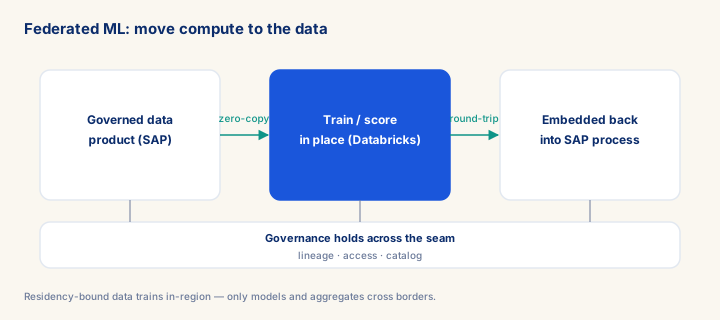
"Federated ML" means three different things in SAP conversations, and a senior architect separates them: data federation for ML (SAP's earlier FedML libraries let hyperscaler ML platforms train on SAP Datasphere data without extraction — the samples repository is now archived), zero-copy sharing (SAP Business Data Cloud Connect for Databricks, generally available since October 2025 on Delta Sharing, plus SAP Databricks and SAP Snowflake inside BDC), and federated learning proper (training across silos by exchanging model updates, not rows — no SAP-branded product). Around them sit SAP AI Core for custom training and serving, the generative AI hub with SAP-RPT-1.5 and TabPFN-3.5 Plus, and in-database ML in SAP HANA Cloud. Decide per use case whether to move data or compute using five questions (reproducibility, feature reuse, residency, provider load, consumption), keep governance intact across the SAP–Databricks seam, and design the round trip back into SAC and planning from day one.
What you will learn
- Distinguish data federation for ML (FedML pattern, now archived), zero-copy sharing (BDC Connect for Databricks/Snowflake, SAP Databricks, SAP Snowflake) and federated learning proper, and say which SAP components deliver each
- Place ML workloads across BDC data products, SAP/customer Databricks, SAP AI Core, the generative AI hub (SAP-RPT-1.5, TabPFN-3.5 Plus) and HANA Cloud in-database ML
- Decide per use case whether to move data or compute using five questions, including residency of hosted model endpoints
- Keep governance and reproducibility across the SAP–Databricks seam and design the round trip, retraining and fallback
Federated ML and AI architecture is the discipline of running machine learning where it makes sense relative to the data — bringing compute to the data, or sharing data live, instead of the reflexive "copy everything into one lake first". In an SAP Business Data Cloud (BDC) landscape the options are concrete and named, and the first job is to stop the word "federated" from meaning three things at once.
Three meanings of "federated" — separate them
1. Data federation for ML. The model trains or scores on SAP data that stays in place, read through a semantic layer. SAP's earlier answer was the FedML Python libraries: sample code and libraries that let AWS SageMaker, Azure Machine Learning, Google Vertex AI and Databricks source SAP and non-SAP data through the federation architecture of SAP Datasphere, without replicating it into the ML platform. The samples repository has since been moved to the SAP-archive organisation on GitHub and archived (last activity November 2025). Treat FedML as a pattern that explains the design intent, not as the product to start a new project on.
Prerequisites
- Intermediate hands-on experience on SAP analytics or data platform projects
- Review core concepts first: C166, C016, C109
Outcomes
- Explain BDC Connect for Databricks (Delta Sharing, Unity Catalog mounting, bidirectional sharing, mTLS + OAuth, GA October 2025) to an enterprise architect
- Produce a design record answering reproducibility, feature reuse, residency, provider load and consumption for a real use case
- Implement the 'federate access, materialise the training set' pattern with versioned tables and MLflow logging
- Design a round trip from a model back into Datasphere/SAC with retraining owner and fallback rule
Full module available to members. The full module adds: the decision framework · the end-to-end scenario walkthrough · the KPI scorecard · the anti-patterns · the code blocks · the knowledge check · the diagrams.