Agentic AI in SAP
As of 2026-10-10
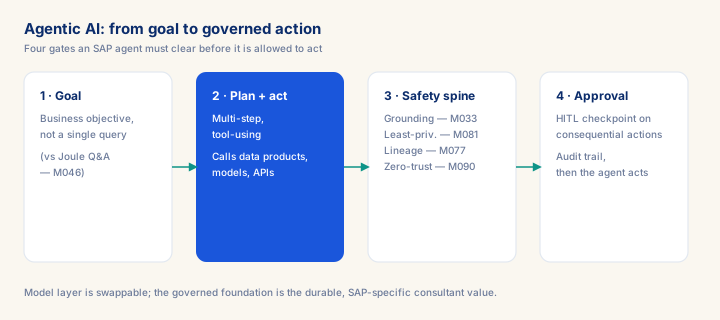
Agentic AI is software that pursues a goal by planning, calling tools and acting. SAP's 2026 map: the SAP Business AI Platform (BTP + Business Data Cloud + Business AI, with the SAP Knowledge Graph at its core), Joule Work as the experience, 50+ Joule Assistants orchestrating 200+ Joule Agents (announced at Sapphire 2026), Joule Studio to build your own (classic edition GA agent builder since Dec 2025; new managed Joule Studio in Early Adopter Care in Q2 2026), SAP AI Agent Hub (SAP LeanIX) to inventory and verify agents, LLMs and MCP servers, and MCP/A2A for interoperability. The senior value is translation and control: say which of copilot, skill, agent or assistant you mean; ground each question on the right source; design authority and identity per hop; place human checkpoints by reversibility; classify EU AI Act exposure (Annex III obligations apply from 2 Dec 2027); cost in AI Units (0.02 per agent action from the Q3 2026 model; custom agents free to run until end-2026); and map every use case to available, early adopter, announced or custom.
What you will learn
- Map SAP's 2026 agentic stack — Business AI Platform, Knowledge Graph, Joule Work, Joule Assistants and Agents, Joule Studio, AI Agent Hub, MCP/A2A — and state each component's availability status with a dated source
- Distinguish copilot answer, skill, agent and assistant using SAP's definitions, and apply the four-property test (goal-directed, multi-step, tool-using, governed) to any agent claim
- Design an agent's grounding, authority and identity per hop, and place human checkpoints according to reversibility
- Classify a use case under the EU AI Act as amended by Regulation (EU) 2026/1744 and build a cost model in AI Units and runtime consumption
Agentic AI is software that pursues a goal by planning, calling tools and acting, instead of answering one question at a time. In SAP's 2026 vocabulary it is the engine of the "Autonomous Enterprise" announced at SAP Sapphire in May 2026. For a senior consultant the job is not to be impressed by that vocabulary but to translate it: which parts are products a client can license today, which are in early adopter programmes, how an agent is actually built and governed, what it costs, and where it is the wrong tool. This module gives you that map, the design rules that make agents safe to deploy on SAP data, and exercises to practise them. Hands-on building is in M326 (agents), M052 (skills), M327 (MCP and A2A) and M055 (orchestration).
1. The 2026 SAP map in one page
SAP's Sapphire 2026 announcement introduced the SAP Business AI Platform, described as a unified foundation combining SAP Business Technology Platform, SAP Business Data Cloud and SAP Business AI, with the SAP Knowledge Graph at its core — a structured map of business entities, processes and relationships. On top of it:
Prerequisites
- Intermediate hands-on experience on SAP analytics or S/4HANA projects
- Review core concepts first: C025, C024, C106
Outcomes
- Explain to a CFO, in five minutes, what SAP's Autonomous Enterprise components are and which are available today.
- Challenge a vendor 'agent' demo with the four-property test and the maturity map.
- Write a six-step authority design and a human-oversight plan for a finance agent.
- Produce a use-case map with maturity, grounding source, EU AI Act class and AI Unit estimate.
Full module available to members. The full module adds: the decision framework · the end-to-end scenario walkthrough · the KPI scorecard · the anti-patterns · the code blocks · the knowledge check · the diagrams.