Migration Wave Planning
As of 2026-10-04
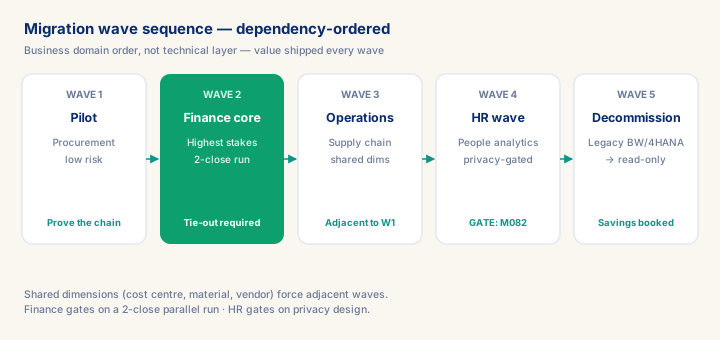
Migrate by business domain in dependency order, never by technical layer or finance-first. Canonical waves: pilot (low-risk, prove the chain) → core finance (max reconciliation, 2-close parallel run) → supply chain → HR (privacy-gated) → decommission. Dependency mapping (shared dimensions force adjacent waves) is the real planning work. Parallel-run is non-negotiable for finance and must be priced honestly. The defensible wave plan is the senior-rate deliverable.
What you will learn
- Sequence a BW/4HANA-to-BDC migration by business domain in dependency order (pilot wave, then core finance, then supply chain/operations, then HR, then decommission) rather than by technical layer
- Build a dependency graph of shared dimensions (cost centre, material master, and similar shared masters) to identify which domains must be grouped into adjacent waves and avoid wave-3 rework
- Design a mandatory parallel run for the core finance wave (minimum 2 close cycles with a formal tie-out) and price the double-running cost honestly to the client
- Produce a dependency-aware wave plan and defend it to a steering committee — the deliverable that commands programme-architect day rates
Module overview
Migration wave planning is the discipline that decides the order in which an organisation moves its analytics estate from BW/4HANA and ECC reporting through Datasphere onto SAP Business Data Cloud — and order is where most programmes win or lose. The junior instinct is to migrate by technical layer (all InfoProviders first, then all queries). The senior approach is to migrate by business domain in dependency order, shipping value every wave and keeping the lights on in legacy until each domain is fully cut over.
Why waves, not big-bang. A big-bang analytics migration freezes reporting for the whole enterprise during the transition and concentrates all risk on one go-live. With ~4,000 customers in the German-speaking region (DSAG) facing the BW migration cliff, the market reality is multi-year, parallel-run programmes — not weekend rip-and-replace. Waves let you (a) prove the target architecture on a low-risk domain, (b) build delivery muscle and tooling before touching finance, and (c) decommission legacy domain-by-domain so licence and infrastructure savings start landing mid-programme.
Prerequisites
- Intermediate hands-on experience on SAP analytics projects
- Review core concepts first: C036, C034, C035
Outcomes
- Work through a realistic scenario: Mid-cap manufacturer, BW/4HANA on-prem + ECC, ~140 BEx queries across finance, procurement, production, HR.
- Recognize and avoid the anti-pattern: Migrating by technical layer (all InfoProviders, then all queries) — No business value until the very end; risk concentrated on one final cutover.
- Apply the module's core decision: First wave domain — choose Low-risk, self-contained domain (procurement/single-plant ops), not Finance or any cross-cutting shared-dimension domain first.
- Track mastery with the KPI: Value shipped per wave (target: Every wave delivers ≥ 1 production domain; red flag: Two consecutive waves with no production cutover).
Full module available to members. The full module adds: the decision framework · the end-to-end scenario walkthrough · the KPI scorecard · the anti-patterns · the code blocks · the knowledge check · the diagrams.