
BW Migration Assessment
As of 2026-11-08T21:00:00.000Z
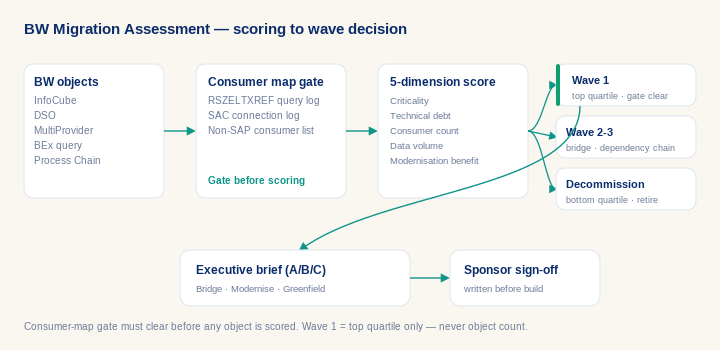
BW migration assessment = 5-dimension scoring (criticality, debt, consumers, volume, modernisation benefit) applied to every InfoProvider, DSO, query and process chain. Consumer mapping is the #1 risk: extract RSDDSTAT_OLAP usage and RSZELTXREF cross-references, crossed with the SAC connection log, before wave 1. Output: scored backlog + executive brief with options A/B/C (lift to SAP BW PCE in BDC + data product generator / selective rebuild in Datasphere / greenfield; the BW bridge only for Datasphere-first estates) + named data owners per domain. Build the inventory from BW statistics (RSDDSTAT) and the SAP Readiness Check for SAP BW/4HANA — BW Modeling Tools are an editor, not an inventory; no DIY spreadsheet.
What you will learn
- Conduct a full BW migration readiness assessment — inventory InfoProviders, classify by criticality, and output a scored migration backlog
- Apply the 5-dimension scoring model (business criticality, technical debt, consumer count, data volume, modernisation benefit) to rank every BW object
- Produce an executive migration brief (A/B/C options with risk, cost, and timeline) that sponsors can sign off without a technical translator
- Identify the three most common assessment anti-patterns (over-scope, under-governance, missed consumer mapping) and apply mitigations on a live backlog
A BW migration assessment is the single highest-leverage artefact on a BW-to-BDC programme. Get it wrong and the next 18 months become a permanent refactor. A senior consultant delivers an assessment in two weeks, not two months — because the discipline is in what you measure, not how long you take.
Scoring the estate and mapping its consumers
The five-dimension scoring model. Every BW object (InfoCube, DSO, MultiProvider, CompositeProvider, BEx query, Process Chain) is scored across five dimensions: (1) business criticality — does a board-level KPI depend on this object? (2) technical debt — how many ABAP custom exits, how many layers of transformation, how old is the source extractor? (3) consumer count — how many queries, reports, SAC stories, and external API callers consume this object? (4) data volume — is this 10M rows or 10B? (5) modernisation benefit — does a Datasphere or BDC equivalent exist that removes the technical debt? Score each 1–5. Sum. The top quartile goes in Wave 1. The bottom quartile is a decommission candidate. Everything in between is Wave 2–3 with explicit dependency chains.
See Figure 1 — inventory to signed option.
Prerequisites
- Intermediate hands-on experience on SAP analytics projects
- Review core concepts first: C036, C034, C035
Outcomes
- Work through a realistic scenario: German Tier-1 automotive supplier, BW 7.5 on-prem, ~4,200 InfoObjects, 1,800 InfoProviders, 680 Process Chains, SAP S/4HANA upgrade underway. Programme wants a Datasphere / BDC target state in 18 months.
- Recognize and avoid the anti-pattern: Assessment by object count alone — Wave 1 is too large; 6-month slip guaranteed.
- Apply the module's core decision: Wave 1 scope — choose: Top quartile by score AND with consumer map complete; avoid: Scoping by object count or technical convenience.
- Track mastery with the KPI: Consumer map coverage (target: 100 % of Wave 1 objects mapped; red flag: Any unmapped consumer in Wave 1 scope).
Full module with the Consultant plan — €19.90/month. The full module adds: the decision framework · the end-to-end scenario walkthrough · the KPI scorecard · the anti-patterns · the code blocks · the knowledge check · the diagrams.
Related guides
These guides cite this page as a source.
Open missions
88 live roles and contracts in SAP BW right now — see the SAP BW missions · freelance SAP contracts.