Testing Strategy for Migrations
As of 2026-10-04
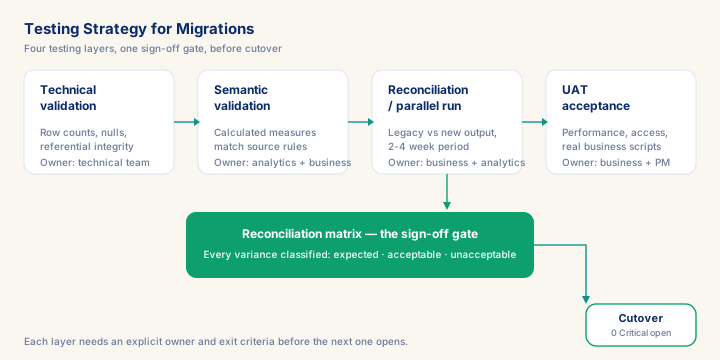
Analytics migrations fail at go-live when testing is treated as QA execution rather than quality architecture. The reconciliation matrix is the business's trust mechanism — if it isn't built, signed off per domain, and tied to agreed numeric tolerances before cutover, the business will not accept the new system on day one. Four distinct testing layers must each have an owner and exit criteria; the five testing failure modes (missing semantic validation, undeclared tolerances, missing performance tests, untested access control, unmasked test data) each cause a different category of go-live crisis.
What you will learn
- Design a four-layer analytics migration testing strategy (technical validation, semantic validation, reconciliation/parallel-run, UAT) — specifying entry criteria, exit criteria, numeric tolerances, and owner for each layer
- Construct a reconciliation matrix for a defined set of business objects and key figures — classifying each variance as expected, acceptable, or unacceptable, with documented resolution
- Diagnose the five testing failure modes on SAP analytics migrations (missing semantic validation, undeclared tolerances, missing performance tests, untested access control, unmasked test data) and prescribe the fix for each
- Produce a migration test plan structure for an analytics workstream — covering test scope, types, entry/exit criteria, defect classification, roles, and timeline relative to cutover
Module overview
A migration testing strategy is not "run the tests after build." It is an end-to-end quality architecture — designed at the start of the migration programme, governing every phase from data load validation through UAT to cutover reconciliation — that determines whether the business trusts the new system on day one. Consultants who conflate testing with QA execution are delivery risks on every migration they touch, because by the time testing starts as an afterthought, the tolerances, the ownership, and the sign-off criteria have never been agreed, and the parallel run becomes a fight rather than a controlled comparison.
Prerequisites
- Review core concepts first: C036, C034, C035
Outcomes
- Design and document all four testing layers for an analytics migration with explicit entry/exit criteria.
- Build a reconciliation matrix with variance classification and resolution documentation.
- Diagnose and remediate each of the five analytics migration testing failure modes.
- Produce a complete migration test plan structure that survives programme review.
Full module available to members. The full module adds: the decision framework · the end-to-end scenario walkthrough · the KPI scorecard · the anti-patterns · the code blocks · the knowledge check · the diagrams.