HANA to HANA Cloud Migration
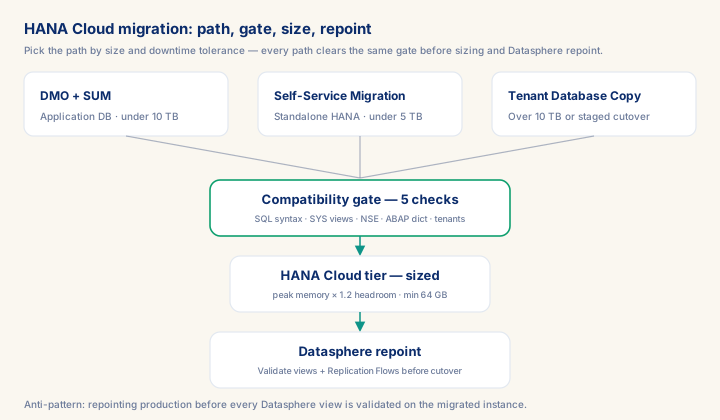
As of 2026-10-04
HANA to HANA Cloud = re-platforming, not lift-and-shift. Three paths: DMO (application DBs < 10 TB), Self-Service Migration (standalone HANA < 5 TB), Tenant Database Copy (large/staged). Five compatibility issues every engagement hits: deprecated SQL, missing SYS views, NSE column-store behaviour, removed ABAP dictionary tables, multi-tenant re-architecture. Sizing: ≥ 64 GB for Datasphere-connected production. Post-migration: re-point every Datasphere connection and validate all views before cutover.
What you will learn
- Execute the SAP HANA Cloud migration path for an on-prem SAP HANA database — apply the Database Migration Option (DMO), Self-Service Migration, or Tenant Database Copy approach based on the landscape profile
- Identify and resolve the five most common HANA-to-HANA Cloud compatibility issues: deprecated SQL syntax, missing system tables, changed column store behaviour, removed ABAP dictionary tables, and multi-tenant re-architecture
- Configure HANA Cloud for production workloads: set memory sizing, enable column store persistence, configure HANA Services (NSE, Streaming, Data Lake), and validate against the original HANA performance baseline
- Design the HANA Cloud migration within a BDC programme — integrate the migrated HANA instance as a Datasphere connection and verify that existing Datasphere views and Replication Flows continue to operate post-migration
Module overview
SAP HANA Cloud is the BTP-native evolution of SAP HANA: the same column-store engine, the same SQL dialect at its core, but delivered as a managed cloud service with a different operational model, a multi-tenant architecture, and a distinct set of compatibility boundaries. The migration from on-premise HANA to HANA Cloud is not a lift-and-shift. It is a re-platforming exercise that exposes every assumption your code, your reports, and your monitoring scripts made about the internals of an on-premise HANA system — assumptions that were invisible for years because nobody had reason to question them until the database they depended on moved.
Prerequisites
- Intermediate hands-on experience on SAP analytics projects
- Review core concepts first: C036, C034, C035
Outcomes
- Select the correct HANA Cloud migration path (DMO, Self-Service, or Tenant Database Copy) for a given landscape size and downtime constraint.
- Run a HANA Cloud Compatibility Report and resolve the five most common blocking issues before a cutover window opens.
- Size a HANA Cloud tier from an on-prem memory baseline and validate query performance within 10 % of the original SLA.
- Re-point a Datasphere connection to a migrated HANA Cloud instance and validate every view and Replication Flow before production cutover.
Full module available to members. The full module adds: the decision framework · the end-to-end scenario walkthrough · the KPI scorecard · the anti-patterns · the code blocks · the knowledge check · the diagrams.