
Cross-Industry Benchmarking
As of 2026-11-07
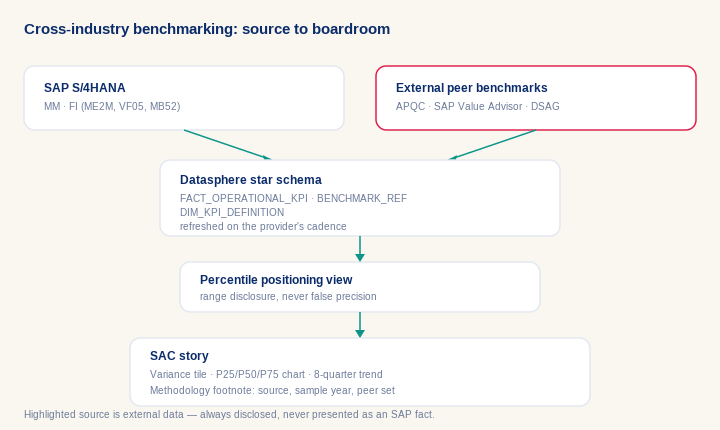
Cross-industry benchmarking answers the question no internal SAP report can: how does this client compare to its peers? It is a value-advisory service, not a reporting exercise — priced from effort and the published day-rate bands rather than from habit, with a fixed-scope entry workshop sized from the consultant days it contains. The decision that matters is peer-set definition: industry, geography, and revenue band, sourced from APQC, DSAG or Eurostat — never a single external number presented as fact. A consultant who builds this once in Datasphere (a repeatable star schema) and presents it in SAC (with disclosed methodology) turns a comparison into a business case a CFO can defend to an audit committee.
What you will learn
- Understand what makes a cross-industry benchmark defensible: peer-set definition, distribution disclosure, and source methodology.
- Build a repeatable benchmark model in Datasphere and present it in an SAP Analytics Cloud story.
- Recognise the five mistakes that undermine benchmarking credibility, from false precision to undisclosed methodology.
- Position benchmarking as a value-advisory service priced from effort and the published day-rate bands, not a reporting task.
Module overview
Cross-industry benchmarking is one of the highest-value services an SAP analytics consultant can deliver, because it answers the question that no internal report can answer: how does this organisation compare to its peers? When a CFO asks "are our procurement costs competitive?" or when a COO asks "is our manufacturing cycle time normal or is it an outlier?", the answer requires data that exists outside the client's SAP system. The consultant who can structure, source, and present that external comparison — rigorously, without fabricating numbers — commands both higher fees and deeper client trust.
Prerequisites
- Intermediate hands-on experience on SAP analytics projects
- Review core concepts first: C045, C087, C083
Outcomes
- Work through a realistic scenario: A European industrial distribution company (~€380M annual procurement spend) wants to know if its procurement organisation is competitive before its next budget cycle.
- Recognize and avoid the anti-pattern: Presenting a single external number as "the industry average" — The client cannot tell if they are compared against a real distribution or an unsourced claim — the deliverable loses defensibility the moment the CFO asks "compared to what sample?".
- Apply the module's core decision: Which benchmark source to anchor on — choose: APQC for standardised process metrics (cycle time, cost per transaction), with industry, cross-industry, revenue and region peer groups; DSAG for adoption and investment context of DACH SAP clients (198 respondents in the 2026 report, too small for percentile peer sets); Eurostat Structural Business Statistics as a free cross-check; avoid: Mixing sources without disclosing it, or defaulting to whichever source is familiar instead of the one with the tightest peer-set fit.
- Track mastery with the KPI: Peer-set validity (target: All 3 axes defined (industry, geography, revenue band) before any number is quoted; red flag: A benchmark quoted with no stated peer set — the single most common integrity failure in this work).
Full module with the Consultant plan — €19.90/month. The full module adds: the decision framework · the end-to-end scenario walkthrough · the KPI scorecard · the anti-patterns · the code blocks · the knowledge check · the diagrams.