ESG & CSRD Reporting
As of 2026-10-10
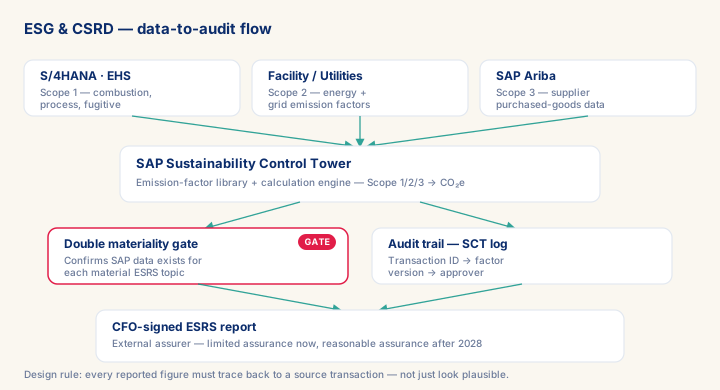
CSRD turns an SAP data-governance problem into a board-level deliverable: an emissions and workforce report signed by the CFO and checked by an external assurer, built from data that already sits in S/4HANA, EHS, SuccessFactors and Ariba but has never been structured for audit. The first decision is not which dashboard to build — it is whether to calculate through SAP Sustainability Control Tower or a custom build, and first-time filers have roughly one reporting cycle to get the emission-factor library and audit trail right before an external assurer tests it. Consultants who can trace a reported emissions figure back to its source transaction — not just make it plausible — are scarce, and that scarcity is the rate lever: this work sits closer to statutory audit support than to BI delivery, and it will stay that way for at least two to three reporting cycles while the first companies file under limited assurance.
What you will learn
- Map each ESRS E1 emission category (Scope 1, 2, 3) to the SAP transaction or module that actually produces the activity data.
- Choose between SAP Sustainability Control Tower, Sustainability Footprint Management, and a custom Datasphere build for a first-time CSRD filing.
- Build a defensible Scope 3 Category 1 calculation and disclose its data-quality gaps instead of hiding them.
- Position CSRD/ESG delivery as audit-adjacent work in the rate conversation, not as a standard BI engagement.
Module overview
ESG and CSRD reporting is not a reporting project — it is a data governance transformation that ends with a PDF signed by the CFO and audited by an external assurer. The European Corporate Sustainability Reporting Directive (CSRD) entered force in 2024 and requires in-scope companies to publish auditable sustainability data alongside financial statements, using the European Sustainability Reporting Standards (ESRS). For SAP analytics consultants, this is a major multi-year engagement opportunity, because the data for Scope 1, 2, and 3 emissions, workforce indicators, and supply chain due diligence already exists in SAP S/4HANA and SuccessFactors — but it is not structured, governed, or auditable in its current form.
Prerequisites
- Intermediate hands-on experience on SAP analytics projects
- Review core concepts first: C044, C087, C083
Outcomes
- Work through a realistic scenario: A French mid-size manufacturer (5 plants, ~2,000 employees, €800M revenue) is CSRD in-scope for its FY2025 report and has never structured its emissions data for audit.
- Recognize and avoid the anti-pattern: Treating CSRD as a one-off reporting project — The assurer returns every year — without a durable data-governance process.
- Apply the module's core decision: SAP Sustainability Control Tower vs Sustainability Footprint Management vs a custom Datasphere build — choose Default to SCT for the first CSRD cycle.
- Track mastery with the KPI: Scope 1/2 calculation variance vs manual baseline.
Full module available to members. The full module adds: the decision framework · the end-to-end scenario walkthrough · the KPI scorecard · the anti-patterns · the code blocks · the knowledge check · the diagrams.