
Stanford AI Index 2026 — decoder for SAP analytics practitioners
As of 2026-11-08
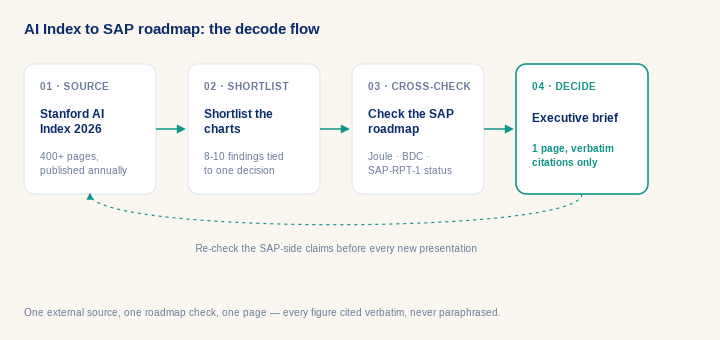
Stanford HAI's AI Index 2026 is the one external benchmark an SAP analytics consultant can cite in a steering committee without sounding like they are reselling SAP's own marketing back to the client — but only if you extract the findings a CFO or CDO actually needs to fund a Joule or BDC line item, not a page-by-page summary. This module trains a 90-minute read of the 400+-page report down to the 3 to 5 findings that change a live SAP decision — adoption, documented AI incidents, agent capability — quoting only figures that are in the report. The deliverable is a 1-page brief citing 3-5 Stanford figures verbatim against a named Tier-1 SAP roadmap commitment (Joule, BDC, SAP-RPT-Decisions/SAP-RPT-TS) — the artefact that turns 'have you read the AI Index' into a paid discovery-phase conversation. Consultants who can produce this brief on demand differentiate from day one of an AI-governance mandate; those who cannot are stuck restating SAP's own slideware.
What you will learn
- Read the Stanford AI Index 2026 takeaways page and chapter footnotes in 90 minutes and fill a figure register with verbatim quote, chapter, population, time window and "cannot tell you" for each kept figure
- Map the incidents (233 to 362), OSWorld (about 66 %) and "spotty" reporting findings to a named SAP control, each with its status word from SAP's 27 Oct 2026 Innovation News Guide
- Write a one-page proceed / pause / narrow brief for a claims-reporting agent with one action, one evidence line and a "would change my mind" line
- Detect an uncitable statistic with the four-question ladder (page, footnote, count versus rate, stated scope)
- Design a 60-case evaluation set with 10 prompt-injection cases and a 95 % release bar, and name who signs the verdict, the set and the register
This module trains one skill: turning the Stanford AI Index 2026 into a one-page decision for an SAP client, with every figure quoted exactly and every figure tied to an SAP analytics control. Everything the Index says about adoption, incidents and agent capability was read on the Stanford HAI 2026 AI Index key-takeaways page on 28 October 2026; the full report sits at aiindex.stanford.edu/report. Where a number is not on that page, the module tells you to read the chapter footnote rather than guessing.
The decision this module trains
Reading the Index is not the skill; anyone can download the 400+ page PDF. The skill is choosing, in under 120 min, the 3 to 5 findings that change a named decision on a client account and dropping the rest. Typical decisions: fund a guardrail programme, delay an agent rollout by one sprint, narrow an agent from "write" to "read and propose", or renegotiate the scope of a pilot.
Prerequisites
- Familiarity with Joule + BDC at the C001-C100 level
- Reading fluency in long-form English research reports
Outcomes
- Identify 3 to 5 Stanford Index findings with direct SAP-analytics relevance.
- Map each finding to an existing SAP product roadmap commitment.
- Produce one 1-page executive brief defended in a 10-minute steering simulation.
Full module with the Consultant plan — €19.90/month. The full module adds: the decision framework · the end-to-end scenario walkthrough · the KPI scorecard · the anti-patterns · the code blocks · the knowledge check · the diagrams.
Open missions
50 live roles and contracts in SAP AI & Joule right now — see the SAP AI & Joule missions · freelance SAP contracts.