
Supply Chain Analytics
As of 2026-11-07
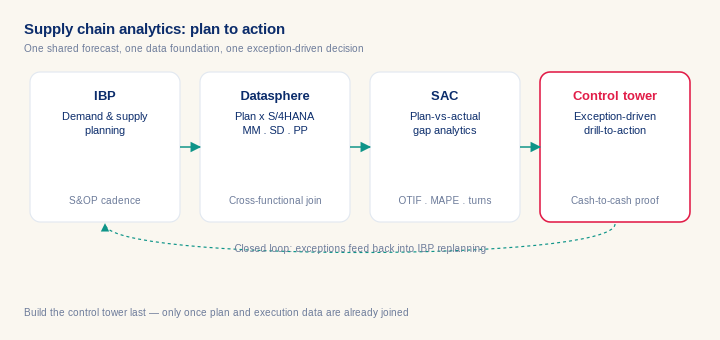
Supply chain moves working capital directly — frame everything in its KPIs (OTIF, forecast accuracy/MAPE, inventory turns, cash-to-cash). SAP IBP owns operational planning; Datasphere builds the cross-functional data products blending IBP plans + S/4HANA execution (MM/SD/PP) + external signals; SAC shows plan-vs-actual. Counter the bullwhip effect with demand sensing and one shared forecast; model at the planning granularity the business executes at, not the finest available. Control-tower analytics is the maturity destination (BDC's unified-foundation pattern). The premium pairs SAP fluency with genuine supply-chain literacy.
What you will learn
- Work through a realistic scenario: an industrial manufacturer on S/4HANA and IBP, with poor forecast accuracy and rising inventory, CFO pushing working-capital reduction, wants a control tower.
- Recognize and avoid framing analytics as data models rather than supply-chain KPIs, which disengages the sponsor and makes analytics look like an IT cost.
- Decide where planning lives: IBP for planning, Datasphere and SAC for cross-domain analytics, and not IBP analytics as the enterprise reporting layer.
- Build a KPI ladder in which every dashboard maps to OTIF, MAPE, turns or cash-to-cash, and flag dashboards that measure data rather than business outcomes.
Module overview
Supply chain analytics serves the Automotive and Industrial demand block, and it is a vertical where analytics moves money directly and visibly. A one-point improvement in forecast accuracy or in inventory turns shows up in working capital within a quarter — not within a strategic planning cycle two years out — which is precisely why supply-chain sponsors fund analytics work readily, on the condition that the consultant can speak their KPIs rather than talk about data models. Worked example (arithmetic, not a benchmark): days-of-supply = on-hand stock ÷ average daily demand, so on €50 M of annual cost of goods sold, cutting 2 days of supply releases about €0.27 M of working capital (50 M × 2 ÷ 365). SAP's own scope for the planning side is on the IBP product page (https://www.sap.com/products/scm/integrated-business-planning.html).
Prerequisites
- Intermediate hands-on experience on SAP analytics projects
- Review core concepts first: C043, C087, C083
Outcomes
- Work through a realistic scenario: an industrial manufacturer on S/4HANA and IBP, with poor forecast accuracy and rising inventory, CFO pushing working-capital reduction, wants a control tower.
- Recognize and avoid framing analytics as data models rather than supply-chain KPIs, which disengages the sponsor and makes analytics look like an IT cost.
- Decide where planning lives: IBP for planning, Datasphere and SAC for cross-domain analytics, and not IBP analytics as the enterprise reporting layer.
- Build a KPI ladder in which every dashboard maps to OTIF, MAPE, turns or cash-to-cash, and flag dashboards that measure data rather than business outcomes.
Full module with the Consultant plan — €19.90/month. The full module adds: the decision framework · the end-to-end scenario walkthrough · the KPI scorecard · the anti-patterns · the code blocks · the knowledge check · the diagrams.