Winning Proposals: Structure That Closes
As of 2026-10-06
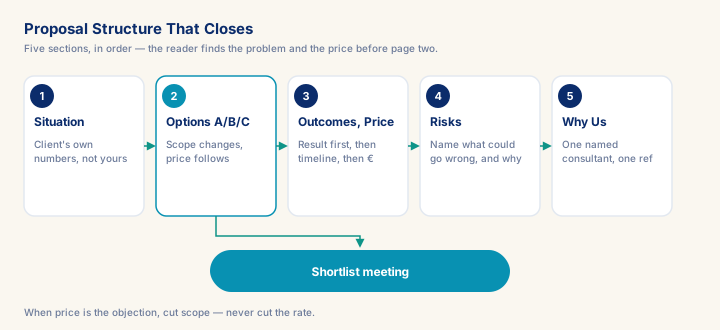
A proposal that opens with credentials instead of the client's problem loses the shortlist before anyone reads page two. This module gives you the five-section structure — Situation, Scoped Options (A/B/C), Outcomes/Timeline/Price, Risks, Why Us — that lets a procurement lead find the number and the outcome in the first ninety seconds. The lever that protects your day rate: when a client pushes back on price, you cut scope (Option B down to Option A), you never discount the rate — a discount signals the original number wasn't credible. Get this structure wrong on a €140K SAC/Datasphere proposal and you don't lose on price, you lose before the technical evaluator even opens the PDF.
What you will learn
- Construct a five-section proposal structure that frames client problems before credentials, using scoped A/B/C options to shift the conversation from yes/no to which option
- Write an executive summary that a non-technical CFO can read in two minutes and extract the specific problem, proposed outcome, and success metric
- Identify and eliminate the six common proposal-killing patterns including feature lists, hidden pricing, and generic methodology sections
- Apply the scoped-option price negotiation technique to defend day rate while accommodating budget constraints by adjusting scope instead of discounting
Why Most Proposals Lose Before They Are Read
The fatal mistake in SAP analytics proposals is burying the answer. A procurement director at a mid-size German manufacturer receives eleven proposals for a Datasphere implementation. She has forty minutes to review them before the vendor shortlist meeting. Ten proposals begin with company credentials, methodology overviews, and a section titled "About Us." One begins: "Your reporting team currently runs 140 manual reconciliations per month to compensate for BW/4HANA data latency. This costs approximately €280K per year in analyst hours and delays the monthly close by three days. We can eliminate 90% of this overhead in sixteen weeks." That proposal gets the meeting.
Start with the problem, not your credentials. The executive summary — which should appear on page one, not as an afterthought — must state in two paragraphs what you understand to be the client's business problem, the cost or risk of inaction, and your proposed outcome. Everything else in the proposal supports this opening. If you cannot write that summary without jargon, you do not yet understand the engagement enough to propose it.
Prerequisites
- Intermediate hands-on experience on SAP analytics projects
- Review core concepts first: C077, C094, C080
Outcomes
- Structure a winning proposal in 5 sections with the right order.
- Write an executive summary that earns a full read in 90 seconds.
- Apply the module's core decision: How many pricing options to present — choose Present three scoped options (A/B/C) that differ in scope, not just price, and position your recommended option in the middle.
- Track mastery with the KPI: Price visible by page one (target: Price shown before page three on every proposal; red flag: Price only in an appendix or deferred to 'a call').
Full module available to members. The full module adds: the decision framework · the end-to-end scenario walkthrough · the KPI scorecard · the anti-patterns · the knowledge check · the diagrams.