
Litigation: When Recovery Fails
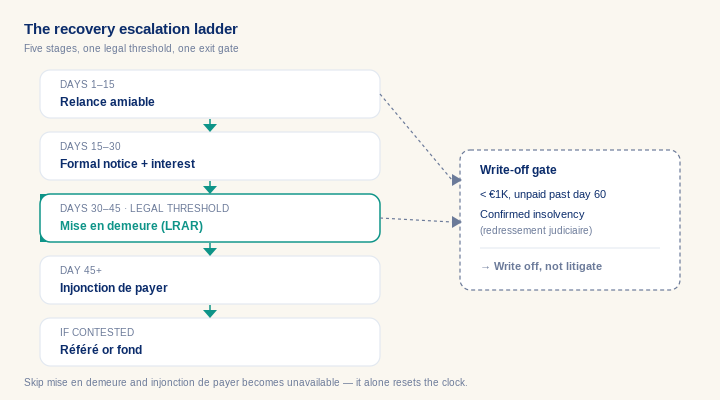
As of 2026-11-07
An unpaid invoice is a financing problem disguised as a relationship problem, and every week without written escalation is a week you extend free credit to your client. This module gives the five-step French recovery ladder — relance, formal notice, mise en demeure, injonction de payer, litigation — and the one step that actually matters: the mise en demeure sent by registered mail, the formal step before court that documents the default and supports the interest claim; it does not interrupt prescription (only the debtor's acknowledgment, a court claim or an enforcement measure does) and it is not required before a court claim. It also gives the write-off math: below roughly €1K, write off after a silent 60 days; above €15K, pursue through injonction or, if contested, litigation, unless there is strong evidence of insolvency. A consultant who runs this ladder consistently recovers money that a consultant who waits and hopes simply donates to the client's cash flow.
What you will learn
- Apply the full escalation sequence -- reminder, formal notice, injonction de payer, court -- selecting the right tool for the debt size and relationship stakes
- Draft a legally effective mise en demeure that documents the default and supports the interest claim, knowing it does not interrupt prescription
- Assess when the collection cost exceeds the recoverable amount and write off decisively rather than spending non-billable hours on irrecoverable debt
- Build contract terms and invoicing habits that reduce late-payment risk before the first invoice is disputed
The anatomy of an unpaid invoice in consulting
Late payment is the most common cash-flow threat for an independent SAP consultant, and it is almost always preventable or recoverable if you move fast and systematically. The client who pays on day 90 instead of day 30 costs you financing. The client who pays on day 180 after a chase costs you time and stress. The client who never pays costs you both the revenue and the write-off hit on your tax return -- if you handle the write-off correctly.
The French escalation framework is the primary reference here. If you operate in other EMEA jurisdictions, the principles are broadly similar but the specific procedures differ. In all cases, consult a lawyer or legal specialist for the actual recovery action; this module gives you the conceptual map. Service-Public Entreprendre describes the amicable and judicial recovery steps for French businesses (Service-Public — amicable recovery; judicial recovery).
Prerequisites
- Intermediate hands-on experience on SAP analytics projects
- Review core concepts first: C055, C051, C060
Outcomes
- Choose between injonction de payer, référé-provision and assignation en paiement.
- Estimate cost and timeline accurately before launching.
- Apply the module's core decision: Escalate now or wait one more cycle? — choose: Move to the step-2 formal notice with interest at day 15 if the amiable reminder produced no written commitment — silence is itself the signal; avoid: Waiting past day 30 hoping relationship pressure will work; every week without a mise en demeure is a week closer to losing judicial options.
- Track mastery with the KPI: Days to mise en demeure (target: ≤ 45 days from the invoice due date; red flag: > 60 days: the evidence trail weakens and the debt drifts toward a default write-off).
Full module with the Consultant plan — €19.90/month. The full module adds: the decision framework · the end-to-end scenario walkthrough · the KPI scorecard · the anti-patterns · the knowledge check · the diagrams.