International Work: Visas, Tax Residency, Permits
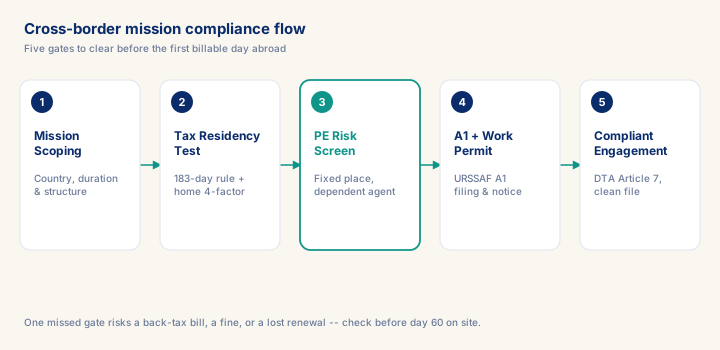
As of 2026-10-04
Every cross-border SAP mission runs on three separate compliance clocks: personal tax residency (the 183-day rule, but decided by your home country's own test first), permanent establishment risk for your company (an eight-month desk at the client's office is a textbook trigger), and social security continuity -- the A1 certificate, filed with URSSAF before the mission starts, not after. Miss any one of the three and a routine assignment can turn into a back-tax assessment or a fine for you and the client. The A1 covers postings of up to 24 months across the EU, EEA and Switzerland: the one number every consultant crossing a border should know before counting days. Consultants who arrive with a clean compliance file get renewal offers -- like the Geneva architect billing EUR 950/day who knows the Swiss notification rules; consultants who trigger a compliance investigation for the client do not, regardless of technical skill.
What you will learn
- Map the tax residency implications of EMEA cross-border work and apply the 183-day rule correctly, including the lesser-known exceptions that make it more complex
- Identify when your client-side presence triggers a permanent establishment risk and structure your engagement to mitigate it
- Navigate A1 social security certificates, work permit requirements, and the practical difference between EU freedom-of-services and third-country posted-worker rules
- Build a pre-mission checklist that covers fiscal, social, and immigration compliance before the first billable day on a cross-border engagement
Why cross-border work in EMEA is more complex than it looks
The SAP analytics market is inherently cross-border. A French independent consultant working on a BDC implementation for a German automotive client, a Spanish SAP Analytics Cloud expert spending three months in Switzerland on a pharma rollout, a Dutch Datasphere architect travelling to Saudi Arabia for a national oil company -- these are normal consulting scenarios. Each involves a layered set of obligations: income tax (which country can tax you and how much), social security (where your contributions go), immigration (do you need a visa or work permit), and for the client, a potential permanent establishment risk that could generate corporate tax liability.
This is not tax or legal advice. Every cross-border situation is specific to your personal tax status, your corporate structure, the destination country, the mission duration, and the contractual structure. Consult a cross-border tax specialist or international employment lawyer before structuring a significant cross-border engagement. This module gives you the framework to ask the right questions.
Prerequisites
- Intermediate hands-on experience on SAP analytics projects
- Review core concepts first: C068, C030, C004
Outcomes
- Apply EU posted worker rules and A1 certificate requirements.
- Manage the 183-day tax residency threshold across jurisdictions.
- Apply the module's core decision: Which treaty article governs your income -- Article 7 or Article 15 — choose If you invoice through your own company.
- Track mastery with the KPI: A1 certificate lead time (target: Filed with URSSAF at least 2 weeks before the mission start date; red flag: A1 filed after on-site work has already begun).
Full module available to members. The full module adds: the decision framework · the end-to-end scenario walkthrough · the KPI scorecard · the anti-patterns · the code blocks · the knowledge check · the diagrams.