Corporate Tax (IS) vs Personal Tax (IR) in France
As of 2026-10-04
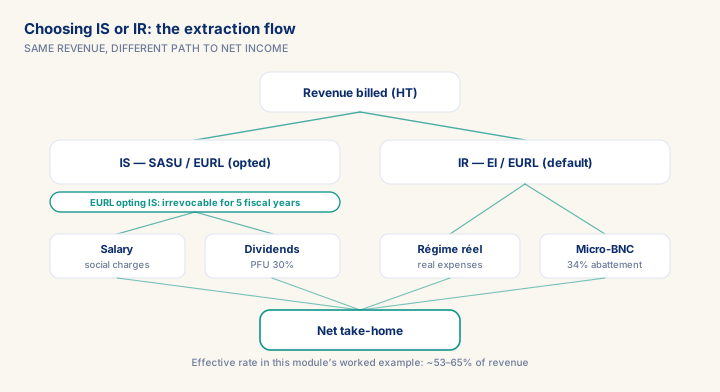
The IS/IR choice fixes your tax-and-charges rate for every euro billed — it is a five-year structural decision, not an annual form. At senior day-rate income, this module's worked model shows a SASU under IS extracting about 53.6% of revenue in tax and charges (salary plus dividend split) versus 55–65% under IR once BNC social contributions are added — a gap of ten-plus points that funds the accountant many times over. The EURL's option for IS is irrevocable for five fiscal years: get the entry decision wrong and you carry the cost of the wrong regime through a full election cycle. The lever IR cannot offer at all: IS lets you retain profit inside the company at 25% in a strong year and draw it down in a lean one, smoothing a volatile consulting income instead of paying peak-rate tax on every good year.
What you will learn
- Explain the structural difference between IS and IR for a French consulting entity, including the tax rates, social charges, and extraction mechanisms that apply under each regime
- Model the net income available to a consultant under a SASU IS structure with salary and dividend combination versus a sole trader IR regime at equivalent revenue levels
- Identify the specific risks of the micro-BNC regime and the EURL IS option irrevocability, and articulate when each represents a costly mistake
- Apply the profit-deferral logic of IS to manage variable consulting income across years with different billing levels
The Fork in the Road: What IS vs IR Actually Means
The choice between Impôt sur les Sociétés (IS) and Impôt sur le Revenu (IR) is not a tax optimisation exercise in isolation — it is a decision about how you want to run your professional life. IS means your consulting structure is a separate taxpayer (a legal entity: SASU, EURL, SARL). IR means the structure's income flows directly onto your personal tax return, as if the entity does not exist for tax purposes (the default for a sole trader / EI or an EURL that has not opted for IS, and for a SARL de famille under specific conditions).
Prerequisites
- Review core concepts first: C002, C083, C075
Outcomes
- Model total tax burden under IS vs IR for your specific profile.
- Apply the 6-factor decision framework.
- Apply the module's core decision: SASU vs EURL opting into IS — choose Default to SASU when ARE eligibility and full health/pension cover matter — the higher charge rate buys real, usable entitlements.
- Track mastery with the KPI: Effective extraction rate (tax + social charges / revenue).
Full module available to members. The full module adds: the decision framework · the end-to-end scenario walkthrough · the KPI scorecard · the anti-patterns · the code blocks · the knowledge check · the diagrams.