
Deductible Expenses: What Actually Passes
As of 2026-11-08
Deductible Expenses: What Actually Passes gives SAP analytics consultants the audit-ready answer to one recurring question: what genuinely reduces taxable profit under a SASU, and what a DGFIP inspector will challenge first. The mechanics are concrete, not vague — a €500 HT tolerance below which small equipment can be expensed at once, with items above it amortised over their useful life (three years is a common estimate for IT, not a legal duration), a home-office ratio taken from the floor plan and consistent with your invoiced on-site days, and a retention rule for every justificatif (10 years from year-end under commercial law, which covers the 6 tax years). Get the balance wrong in either direction: under-claim and your effective tax rate inflates your day-rate math; over-claim and a redressement costs far more than the deduction was worth. This is the module to open before the accountant call, not after the tax notice.
What you will learn
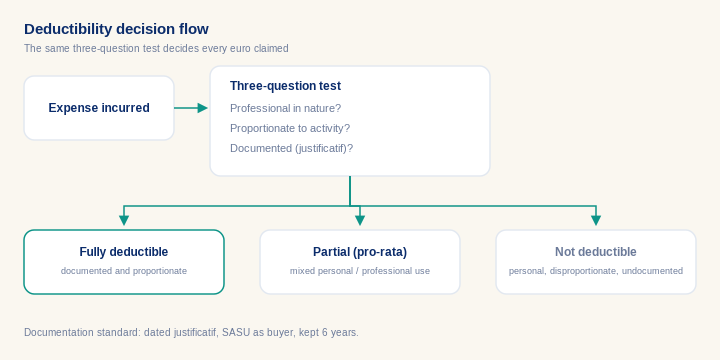
- Apply the three-question deductibility test (professional nature, proportionality, documentation) to common consultant expenses
- Distinguish between expenses that can be fully deducted, partially deducted, or not deducted under French tax rules for SASU
- Build a compliant documentation system for receipts and travel logs that holds up under a DGFIP audit
- Avoid the four most common deductibility mistakes that trigger tax reassessments
The substance-over-form test that the tax inspector actually applies
French tax deductibility of professional expenses rests on article 39 of the Code Général des Impôts and the general conditions the DGFiP publishes: the expense must be incurred in the direct interest of the business, fit normal management (neither excessive nor fictitious), be booked in the financial year it relates to, not be the counterpart of a fixed asset, and be backed by supporting documents such as invoices (impots.gouv.fr — what can I deduct from my professional results, updated 14 October 2026). In practice, an inspector examining a SASU return asks three questions: Is the expense professional by nature? Is it proportionate to the activity? Is it documented?
For a consultant billing SAP analytics projects, most deductible categories are straightforward — but the boundary cases are where audits live. This module maps the real landscape, including what actually gets challenged.
Disclaimer: This is orientation for informed conversations with your accountant. Tax rules evolve, and the right answer depends on your exact situation. Consult a chartered expert-comptable before treating any specific item as deductible.
Prerequisites
- Review core concepts first: C075, C073, C038
Outcomes
- Map the main deductible expense categories for SAP consultants (home office, hardware, training, travel, software).
- Set the home-office and vehicle deduction at defensible, auditable levels.
- Apply the €500 HT expensing tolerance correctly and set the amortisation period with the expert-comptable (three years is an estimate, not a rule).
- Build a receipts and documentation system that holds up in a DGFIP control.
Full module with the Consultant plan — €19.90/month. The full module adds: the decision framework · the end-to-end scenario walkthrough · the KPI scorecard · the anti-patterns · the knowledge check · the diagrams.