Umbrella Company vs Independent
As of 2026-10-03
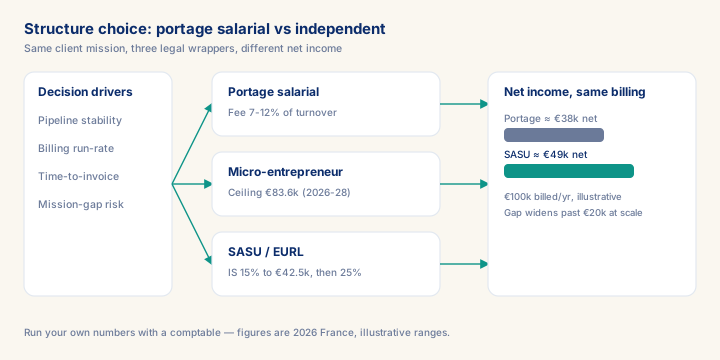
The choice between portage salarial and an independent structure is a net-income and solvency decision, not an admin preference: at €100,000 billed per year the gap between the two paths already reaches roughly €9,000–11,000 net, and widens past €20,000 once billing reaches €200,000, because the portage fee tracks revenue while corporate tax stays flat on profit. Portage salarial (7–12% of turnover) buys chômage rights and zero admin burden — the right call in the first 12 months or when a mission starts before any structure exists. SASU or EURL wins on economics once billing clears roughly €7,000/month and 12 months of mission history de-risks the chômage safety net, but it costs 1–3 weeks of setup lag and an annual comptable relationship (€1,200–2,400/year). Micro-entrepreneur only works below the 2026 ceiling of €83,600 and only if real professional costs stay under the flat 34% abatement. Get the timing wrong and you either pay portage fees for years past the point they earn their keep, or drop legal and income protections before you can self-insure them.
What you will learn
- Compare portage salarial and independent structures (SASU/EURL/micro-entrepreneur) across net income, social charges, and administrative burden
- Calculate the real cost of portage salarial and understand what you are buying with the fee
- Identify which structure fits your current stage as an SAP analytics consultant — entering freelance, growing, or scaling
- Anticipate the inflection points where switching structures makes financial sense
The choice between portage salarial and going fully independent is the first major financial decision of an SAP analytics freelance career — and it is rarely revisited carefully enough. Most consultants make it under time pressure, when a client says yes and asks for a contract to be signed within two weeks. This module gives you the framework to make it deliberately, with numbers attached.
Before anything else: the figures and structures described here are specific to France as of 2026. Tax law, social contribution rates, and corporate forms change. This is not professional legal or accounting advice — run your specific numbers with a comptable or expert-comptable before committing to a structure.
What Portage Salarial Actually Buys You
Portage salarial is a three-party arrangement: you work for a client, but you are legally an employee of a portage company (société de portage). The portage company invoices your client, collects the fee, deducts its management charges (typically 7–12% of turnover), and pays you a salary with full employment law protections.
Prerequisites
- Review core concepts first: C068, C038, C055
Outcomes
- Run a full net-income comparison between portage salarial and an independent structure (SASU/EURL/micro) at the same billing level.
- Identify which situations call for portage salarial versus an independent structure, based on pipeline stability, billing run-rate, and time-to-invoice.
- Explain the cost mechanics of the portage fee, SASU IS/PFU, and the micro-entrepreneur abatement and ceiling.
- Apply a repeatable decision checklist to a real mission-signing scenario within the module's 15-minute lab format.
Full module available to members. The full module adds: the decision framework · the end-to-end scenario walkthrough · the KPI scorecard · the anti-patterns · the knowledge check · the diagrams.